Paidnice vs ezyCollect is a choice between charging late payers and scoring customers before granting credit. Choose Paidnice for on-ledger late fees and interest on Xero or QuickBooks Online, from US$69 a month with no setup fee. Choose ezyCollect for Experian credit scores and Australian ERP reach, last published at A$275 a month, now hidden, request a quote.
Paidnice computes invoice late fees and statement interest per customer group and posts them back to the ledger in Xero or QuickBooks Online, from US$69 a month with no setup fee.
ezyCollect, part of Sidetrade since October 2025, pairs collections workflows with Experian credit data and the deepest Australian ERP list in the category, from a last-published A$275 a month on an annual contract plus a setup fee from A$900.
For an Australian wholesale or trade business the second sentence usually settles it before the first, because ezyCollect connects to MYOB, Pronto Xi, SAP Business One and Attaché and Paidnice reaches other ERPs only on its Custom plan. That test comes second below, and it is short.
Choose ezyCollect for credit risk scoring and Australian ERP reach; choose Paidnice for a lower entry price, on-ledger late fees and interest, and a Xero or QuickBooks Online ledger.
What debtor management software is (and what it is not)
Debtor management software works the accounts a business has already given credit to: it chases overdue invoices, issues statements, takes payment and escalates. Paidnice and ezyCollect are both listed under Debtor management on the Australian Xero App Store.
Between them, the two products on this page cover these jobs:
- Reminder workflows across email and SMS, plus letter, fax and call tasks in ezyCollect; Paidnice adds two-way SMS and WhatsApp replies and in-app calls on Pro and up
- Statements, monthly in ezyCollect and on any schedule in Paidnice
- Payment plans and a customer payment portal
- Late fees and statement interest posted to the ledger, which only Paidnice computes
- Credit scoring from Experian data, which ezyCollect includes; Paidnice runs native checks from payment behavior, plus Creditsafe via API on the Custom plan
It is not the ledger or the ERP. The receivable stays in Xero, QuickBooks Online, MYOB, Pronto Xi or another system, and the software reads it, which is why the ledger test comes first on this page.
It is not a collection agency. ezyCollect refers an account to partner agencies from 25 percent of what is recovered, and Paidnice keeps the escalation as a case your team works.
Where it sits: Paidnice is native to Xero and QuickBooks Online, with MYOB, NetSuite, Sage Intacct, Dynamics 365 Business Central and SAP Business One as Custom-plan builds. ezyCollect connects as standard to MYOB, Pronto Xi, SAP Business One, Attaché and the rest of the Australian mid-market stack.
Score the customer first, or charge them later
Both products work the same customer at opposite ends of the relationship, and the Australian data says why the front end carries more weight in this market than in most.
Xero Small Business Insights, June 2026 quarter.
An Australian small business waits 20.3 days to be paid, down from 24.6 a year before, and settles 4.3 days past due against 7.0. The sector split is the number that decides this page: wholesale trade waits 27.6 days against 15.6 in retail.
Wholesale extends real credit terms to businesses that then use them, so the risk is created when terms are granted and realized weeks later.
That is the case for the front end. Credit Insights combines your aged trial balance and payment terms with Experian bureau data into risk groups and credit scores, so an account that should never have had 30 days can be caught before the invoice exists.
And that is the case for the back end, because a credit score collects nothing. Paidnice raises an invoice late fee per overdue invoice and a statement interest charge on the whole overdue balance, both as posted documents on the ledger, which puts them into the customer’s own payables and their next payment run.
Card surcharging is the only charge ezyCollect adds, and a surcharge is paid by the customer who pays, not by the customer who is late.
If the ledger is MYOB or Pronto Xi, check the plan first
This is the one comparison in the category where the ledger decides the plan: Paidnice is native to Xero and QuickBooks Online, and every other ledger is a Custom-plan build.
ezyCollect connects Xero, MYOB AccountRight, Exo, Essentials and Acumatica, QuickBooks Online, NetSuite, Dynamics, Sage 300 and Sage Intacct, SAP Business One, Pronto Xi, Attaché, JCurve, ABM, Wisei and CSV. That list is the Australian mid-market stack, and it is most of what a wholesale or trade business is actually running.
Paidnice is native to Xero and QuickBooks Online. MYOB, NetSuite, Sage Intacct, Dynamics 365 Business Central, SAP Business One and other cloud ERPs connect on the Custom plan, set up by an implementation specialist.
So the test is one question. If your receivable lives in MYOB AccountRight, Pronto Xi, SAP Business One or Attaché, ezyCollect connects as standard, and Paidnice needs a Custom-plan build.
If it lives in Xero or QuickBooks Online, both connect and the comparison below applies. On the Xero store itself Paidnice holds 5.0 from 83 reviews and ezyCollect 4.94 from 35 on the Australian store, both on the Xero App Store listings.
ezyCollect vs Paidnice
The short verdict, for a reader who wants the answer before the working. Choose Paidnice if the ledger is Xero or QuickBooks Online and the problem is slow payers. It posts late fees and statement interest to the ledger as documents, runs per-invoice reminder ladders inside customer groups, and starts at A$99 a month with no setup fee.
Choose ezyCollect if you need Experian credit scores before you grant terms, in-app demand letters, cash application, or a connector for MYOB, Pronto Xi, SAP Business One or Attaché.
ezyCollect’s entry plan is A$275 a month on an annual contract plus A$900 setup (last published; now hidden, request a quote). Check current pricing with the vendor.
Xero App Store ratings: Paidnice 5.0 from 83 reviews, ezyCollect 4.94 from 35 on the Australian store.
1. Paidnice

Best for an Australian or New Zealand business on Xero or QuickBooks Online that wants the charge as well as the reminder, any size up to $50m a year, or 50,000 invoices a year
What is it best for?
For a business whose customers can pay and choose not to yet, where the missing lever is a cost attached to being late rather than a better view of who is.
- Fits
- Businesses on Xero and QuickBooks Online of any size up to $50m a year, or 50,000 invoices a year, with or without a credit controller
- Regions
- Australia, New Zealand, United Kingdom, United States, Canada, South Africa
- Entry cost
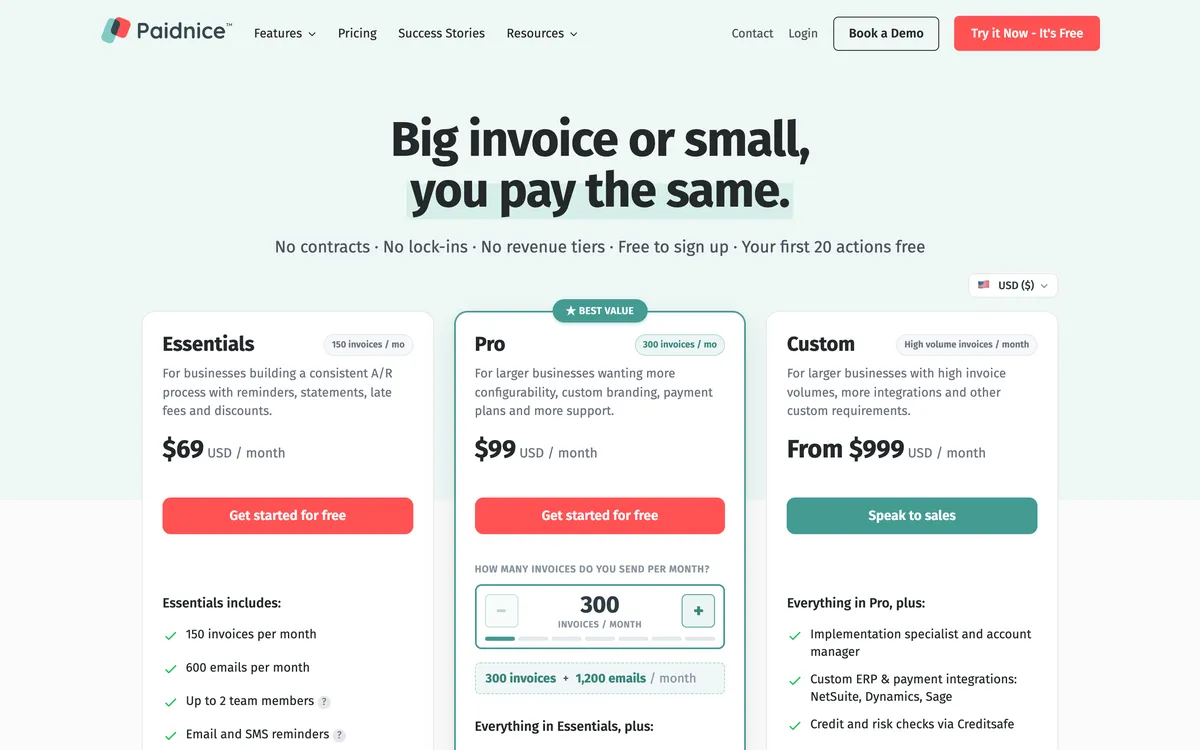
- US$69/mo on Essentials, covering 150 invoices, 600 emails and up to 2 team members; Pro from US$99/mo with unlimited users and no per-seat fee. Local price tables rather than FX conversion, so A$99 and £49 for the same tier.
- Rated
- 5.0 from 83 Xero App Store reviews; 4.9 from 14 on Capterra · Xero App Store listing
- Awards
- Winner, New Zealand Small Business App of the Year, Xero Global App Awards 2026; 2025 Xero Global Small Business App of the Year
- Runs on
- Xero, QuickBooks Online, Stripe, Pinch Payments, CloudDepot, HubSpot, Pipedrive, Zapier. NetSuite, Sage Intacct, MYOB and Dynamics 365 Business Central on the Custom plan only
- Late fees and interest
- Yes, per customer group. Flat, percentage and compounding charges, with a Bank of England base rate toggle for UK invoices that applies the correct base rate for each period an invoice spans, raised on the ledger as Draft or Approved
- Does best
- Two charge types on the same customer group, an invoice late fee per overdue invoice and a statement interest charge on the whole overdue balance, both posted to the ledger
Paidnice acts per invoice and per customer group, not per customer, so the charge and the reminder can carry different rules for the same account.
A wholesale group, a retail group and a disputed-accounts group each run their own policy at the same time, and two charge types are available on any one of them: an invoice late fee per overdue invoice, and a statement interest charge on the whole overdue balance.
The charge is raised on the ledger as a posted invoice, Draft or Approved. Only a posted document enters the customer’s own payables, their aged payables report and their next payment run.
Statement interest recalculates at the moment the statement sends rather than at the last policy run, so the balance the customer opens is accurate that morning, and it is netted against any credit on the account. Compounding is on by default; simple interest is the deliberate choice.
Around it runs the ordinary ladder: reminders by email and SMS from your own authenticated domain, statements on any schedule including consolidated parent and child accounts, prompt payment discounts, payment plans with deposits and auto-pay through Stripe and Pinch Payments, a customer payment portal, and escalations run as cases with an owner per contact, triggered by days overdue or a credit-limit breach.
Paidnice uses AI to read customer replies, detect PO requests, log payment promises, find the reason behind a dispute and draft the answer. A person approves a draft before it sends, unless you pre-approved that type of action. Its MCP server, on Pro and Custom, connects Claude, ChatGPT or any agent with a custom connector to triage replies, log promises and disputes, send reminders and work escalations, with one connection for every organisation.
There are no contracts and no lock-ins, and further Xero or QuickBooks organisations are A$39 (US$29) per entity a month.
Limitations with Paidnice. There is no cash application.
It is native to Xero and QuickBooks Online only. MYOB, NetSuite, Sage Intacct, Dynamics 365 Business Central, SAP Business One and other cloud ERPs connect on the Custom plan, set up by an implementation specialist.
Posted demand letters are on Pro and up, on request, and Paidnice has no agency referral of its own, though an escalation can be routed to any agency or solicitor you choose. The entry tier covers two team members, and unlimited users start on Pro.
Best suited for: Australian or New Zealand businesses on Xero or QuickBooks Online that want a charge on late invoices as well as the reminder. The drawback is that there is no cash application.
2. ezyCollect

Best for an Australian wholesale or trade business that extends real credit terms, priced by debtor count from 200 to 3,000
What is it best for?
For a distributor or trade supplier whose losses are made at the point terms are granted, on a ledger that Xero and QuickBooks Online tools cannot read.
- Fits
- Australian wholesale, distribution and trade businesses with a credit function. No revenue band published; tiers are set by debtor count, from 200 debtors on the entry plan to 3,000 on the top one
- Regions
- Founded in Sydney in 2014, sells across Australia and New Zealand, part of Sidetrade since October 2025
- Entry cost
- A$275/mo on ezyStart on an annual contract, covering 200 debtors, 3 users and 1 workflow, plus a one-off setup fee of A$900; monthly billing runs about 20 percent higher, so about A$330. ezyGrow A$950, ezyScale A$2,350, ezyUltimate on quote, each with setup up to A$3,900. Last published; ezyCollect now hides its pricing, request a quote.
- Rated
- 4.94 from 35 Xero App Store reviews on the Australian store; 4.7 from 25 on G2; 4.9 from 12 on Capterra; 4.6 on Trustpilot · Xero App Store listing
- Awards
- None found
- Runs on
- Xero, MYOB AccountRight, Exo, Essentials and Acumatica, QuickBooks Online, NetSuite, Dynamics, Sage 300 and Sage Intacct, SAP Business One, Pronto Xi, Attaché, JCurve, ABM, Wisei and CSV
- Late fees and interest
- None found. No late fee, interest or statutory charge appears in the help center or in the July 2026 relaunch materials; automatic and customer-level card surcharging is the only charge the product adds
- Does best
- Credit Insights, which combines your aged trial balance and payment terms with Experian bureau data into risk groups and monthly credit scores
The Australian ERP list is the reason most buyers get here, and it is the widest in the category: MYOB AccountRight, Exo, Essentials and Acumatica, Pronto Xi, SAP Business One, Attaché, JCurve, ABM, Wisei, Sage 300 and Sage Intacct, NetSuite and Dynamics, alongside Xero, QuickBooks Online and CSV.

For a wholesale business on Pronto Xi that list is the whole shortlist.
Credit Insights is the second reason. It combines your aged trial balance and payment terms with Experian bureau data into risk groups and credit scores, so an account that should not have been given 30 days can be caught before the invoice is raised.
Auto cash application matches receipts and writes them back to the ERP, and the SimplyPaid portal takes cards, Apple and Google Pay, direct debit, EFT and ACH. Escalation carries on past the software into in-app demand letters and then a manual referral to partner collection agencies.
ezyCollect was founded in Sydney in 2014 and acquired by Sidetrade in October 2025. Its AI layer, Aimie, is in early access.
Collections themselves run as customer-level workflows: a pre-reminder and a set of follow-up steps (six in the help center's example) across email, letter, SMS, fax and call tasks, with overdue invoices consolidated into one message per customer. Payment plans are a paid add-on, set up at the invoice or customer level.
Limitations with ezyCollect. No late fee or interest function is documented anywhere in its materials, so a late invoice costs the customer nothing inside ezyCollect and card surcharging is the only charge it adds.
Pricing carries a setup fee of A$900 on the entry tier and up to A$3,900 above it, monthly billing runs about 20 percent above the annual rate, and letters, SMS and fax are charged on top, with a A$90 plus GST monthly gateway fee on card payments.
In-app demand letters are A$49 plus GST each and agency referral starts at 25 percent of the amount recovered. Customers who reach the end of a workflow window get no further automated follow-ups, and no public API documentation was found.
Best suited for: Australian wholesale or trade businesses that extend real credit terms on an ERP such as MYOB, Pronto Xi or SAP Business One. The drawback is no late fee or interest function, plus a setup fee from A$900 on an annual contract.
ezyCollect debtor management Australia
ezyCollect manages Australian debtors as accounts: one customer-level workflow, Experian credit scoring, monthly statements, payment plans and a referral path to collection agencies.
It is listed on the Australian Xero App Store under Debtor management and Payments, at 4.94 from 35 reviews. The debtor workflow runs at customer level, a pre-reminder and a set of follow-up steps (six in the help center's example) across email, letter, SMS, fax and call tasks, with overdue invoices consolidated into one message per account. Letters, SMS and fax are metered extras.
Around the workflow sit the pieces a credit function expects: Credit Insights risk groups built from your aged trial balance and Experian bureau data, automated monthly statements, installment plans as a paid add-on, in-app demand letters at A$49 plus GST, and a manual referral to partner agencies from 25 percent of what is recovered.
The entry plan covers 200 debtors, 3 users and 1 workflow, at A$275 a month on an annual contract plus A$900 setup (last published; now hidden, request a quote). It charges a late debtor nothing: no late fee or interest function is documented.
Twelve months of ezyCollect, all charges included
ezyCollect publishes no setup fee on its own site. The setup figures below come from the last-published price list, so confirm them in your quote.
| Line | Paidnice Essentials, first 12 months | ezyCollect ezyStart, first 12 months |
|---|---|---|
| Best for | Australian wholesale and trade businesses scoring credit on an ERP | Xero or QuickBooks Online businesses that want on-ledger late fees |
| Subscription | A$99 × 12 = A$1,188 | A$275 × 12 = A$3,300, on an annual contract |
| Setup | None | A$900, one off |
| Card gateway | None | A$90 + GST × 12 = A$1,080 |
| Demand letters, ten of them | Posted letters on Pro and up, on request; local price on request | A$49 + GST × 10 = A$490 |
| First-year total | A$1,188 | A$5,770, plus GST on the metered lines |
ezyCollect prices are last published; ezyCollect now hides its prices, request a quote. ezyStart is sized for 200 debtors, 3 users and 1 workflow.
Paidnice Essentials covers 150 invoices, 600 emails and 2 team members, priced from a fixed local table rather than an FX conversion. Every figure above is ezyCollect’s or Paidnice’s own published number, and no vendor paid for a line of it.
Three variables move the left-hand column. Monthly billing instead of annual runs about 20 percent higher, so ezyStart becomes about A$330 a month and the subscription line becomes roughly A$3,960.
The ezyGrow tier is A$950 a month for 500 debtors, with setup up to A$3,900. Agency referral, if it gets that far, is 25 percent of whatever is recovered, and letters, SMS and fax are metered throughout.
The Paidnice column has a short list of extras: SMS at A$0.15 a message and A$39 a month for each further Xero or QuickBooks Online organisation. Unlimited users start on Pro rather than on the entry tier.
The comparison changes once bureau scoring is needed below the Custom plan, where Paidnice runs Creditsafe checks; its native checks run on every plan. What the roughly A$4,600 difference buys over a year is Experian credit scores and monitoring, cash application written back to the ERP, in-app demand letters, and connectors Paidnice does not have.
If none of those four is on your list, the difference is headroom you are paying for.
One message per customer, or one policy per invoice
The two products chase at different grain, and on a trade account with a long tail of overdue invoices the difference is visible in the customer’s inbox.
Take one wholesale account with eleven overdue invoices: four at 7 days, five at 35 days and two at 92 days.
ezyCollect sends one message. Collections run as customer-level workflows, a pre-reminder and a set of follow-up steps (six in the help center's example) across email, letter, SMS, fax and call tasks, with the overdue invoices consolidated into a single message per customer.
The account moves through the workflow as one unit, at whichever step its position dictates, which means the two invoices at 92 days are chased at the same intensity as the four at 7. That is the right shape for a relationship you intend to keep.
Paidnice runs the policy per invoice, inside a customer group. The four at 7 days get the first reminder, the five at 35 get the escalated one, and the two at 92 carry the late fee, all against the same account on the same day.
A statement then consolidates the balance, including across parent and child accounts, and the statement interest charge is calculated on the whole overdue balance rather than invoice by invoice.
Neither model is better in the abstract. One optimises the conversation and the other optimises the pressure, and a wholesaler with eleven overdue invoices on one account usually already knows which of the two it needs this quarter.
Both schedule installments, with the same difference in shape. ezyCollect sells Payment Plans as a paid add-on, set up at the invoice or customer level with a direct debit authority.
Paidnice takes deposits, installments and auto-pay through Stripe and Pinch Payments from the same policy set as the reminders, so an account on a plan comes off the fee policy while the reminder ladder keeps running.
Paidnice debtor management Australia
Paidnice manages Australian debtors invoice by invoice inside customer groups: reminders, statements, late fees and statement interest posted to Xero or QuickBooks Online, from A$99 a month.
It is listed on the Australian Xero App Store under Debtor management and Invoicing and jobs, at 5.0 from 83 reviews.
Each customer group carries its own policy: a reminder ladder keyed to the due date, scheduled statements consolidated across parent and child accounts, and a late fee per overdue invoice or interest on the whole overdue balance, both raised as documents on the ledger.
Australian pricing is a fixed local table: Essentials is A$99 a month for 150 invoices, 600 emails and 2 team members, Pro starts at A$139 for 300 invoices with unlimited users, a further Xero organisation is A$39 a month and SMS is A$0.15 a message.
No setup fee, no annual contract. Paidnice refers nothing to an agency itself; escalation is a case your team works, and you can route it to any agency you choose.
Paidnice and ezyCollect compared: the table
Two rows carry most of the decision: ledger integrations, and the late fee grain. The rest is detail you can hold until the shortlist is down to one.
| |
|
|---|---|---|
| Revenue fit | Any size up to $50m a year, or 50,000 invoices a year | Not published (priced by debtor count, 200 to 3,000) |
| From (monthly) | US$69 | A$275 on an annual contract, plus setup from A$900 (last published; now hidden, request a quote) |
| Ledger integrations | Xero, QuickBooks Online | Xero, MYOB AccountRight, Exo, Essentials and Acumatica, QuickBooks Online, NetSuite, Dynamics, Sage 300 and Sage Intacct, SAP Business One, Pronto Xi, Attaché, JCurve, CSV |
| Late fee grain | Yes (per customer group) | None found |
| Statements | Yes (any schedule, including consolidated parent accounts) | Yes (monthly) |
| Payment plans | Yes | Yes (enabled by support) |
| Portal | Yes | Yes (SimplyPaid) |
| Credit checks | Yes: native checks from payment behavior, plus Creditsafe via API on the Custom plan | Yes (Experian data, risk groups and debtor monitoring) |
| Cash application | None found | Yes (with write-back to the ERP) |
| AI | Yes (Paidnice says it reads replies and drafts the answer; a person approves) | Yes (AIMIE, collection priorities and benchmarking) |
| AI | Advanced Reads customer replies, drafts answers and follow-up actions (like PO updates) for your approval; MCP server for Claude, ChatGPT and other agents | Basic an AI email template generator as a paid add-on; Aimie is in early access |
| Rated (source, count) | 5.0 (83, Xero App Store) | 4.94 (35, Xero App Store AU) |
"Not documented" means the vendor does not document the capability. "Not published" means the vendor does not print a price. "None found" means no evidence either way. Prices are the vendor’s published or last-verified from-price.
Credit scoring before the invoice against a charge after it
The capability each product has and the other does not, described as what it changes rather than as a feature name.
On the ezyCollect side: bureau scores and risk groups from Experian, with a credit limit attached, and auto cash application that matches receipts and writes them back to the ERP.
It also has in-app demand letters at A$49 plus GST each, and a manual referral to partner collection agencies from 25 percent of what is recovered.
Paidnice has no cash application. It runs native credit checks from payment behavior on every plan and Creditsafe bureau checks through the API on the Custom plan, and posted letters are on Pro and up, enabled on request.
On the Paidnice side: flat, percentage and compounding charges running as a policy under a customer group, with compounding on by default and simple interest as the deliberate choice. A Bank of England base rate toggle applies the correct base rate for each period a UK invoice spans, which matters for an Australian business invoicing UK customers.
Both charge types can run on the same group, interest is netted against any credit on the account, and a single disputed invoice can be excluded by its reference without moving the customer. ezyCollect documents no late fee, interest or statutory charge anywhere in its help center or its July 2026 relaunch materials.
Neither tool is an external recovery agency. ezyCollect refers an account to partner agencies and goes no further itself. Paidnice keeps the escalation as a case on somebody’s list, and choosing an agency is your decision to make.
| Plan | Monthly price | Includes |
|---|---|---|
| Paidnice Essentials | US$69 | 150 invoices, 600 emails, up to 2 team members; late fees, interest, statements and escalations |
| Paidnice Pro | From US$99 | From 300 invoices, unlimited users; email allowance scales with the tier, up to 4,000 invoices a month |
| Paidnice Custom | From US$999 | Quoted for your setup at any invoice volume; custom ERP and payment integrations, invoice API access, implementation specialist and dedicated account manager |
| ezyCollect ezyStart | A$275 (last published; now hidden, request a quote) | 200 debtors, 3 users, 1 workflow, on an annual contract. Setup A$900 |
| ezyCollect ezyGrow | A$950 | 500 debtors, 5 users, 3 workflows. Setup up to A$3,900 |
| ezyCollect ezyScale | A$2,350 | 1,500 debtors, 10 users, 5 workflows. Setup up to A$3,900 |
| ezyCollect ezyUltimate | Not published | 3,000 debtors, 20 users, 10 workflows, on quote. Setup up to A$3,900 |
Taken from each vendor’s published tier list. ezyCollect figures are Australian dollars on an annual contract, and monthly billing runs about 20 percent higher, so ezyStart is about A$330. Paidnice bills from a fixed local price table, so Essentials is A$99, £49, C$89, €59, NZ$109 excluding GST or R1,100.
What Sidetrade’s AI plans have shipped so far
ezyCollect was acquired by Sidetrade in October 2025, and it has announced Aimie, an AI collections product.
Aimie, Augmented Collections and Business Intelligence are in early access and not generally available. The AI that is live is an email template generator, sold as a paid add-on.
According to Paidnice, its AI reads inbound replies and drafts the answer, and a person approves a drafted reply before it sends unless that type of action was pre-approved.
Which debtor management software fits your use case?
Start from the ledger, then from where the losses happen: when terms are granted, or after the invoice goes unpaid.
| Use case | Start with | Why |
|---|---|---|
| Ledger on MYOB, Pronto Xi, SAP Business One or Attaché | ezyCollect | Standard connectors; Paidnice needs a Custom-plan build. |
| Credit scores before granting terms | ezyCollect | Experian data, risk groups and debtor monitoring. |
| Slow payers on Xero or QuickBooks Online | Paidnice | Late fees and statement interest posted to the ledger as documents. |
| Reminders and statements only, no late fees, on a small budget | Paidnice | A$99 a month with no setup fee, against an ezyCollect first-year total of about A$5,770. |
| Cash application written back to the ERP | ezyCollect | Auto cash application matches receipts; Paidnice has none. |
Questions from Australian wholesale and trade teams
The questions that come up on a trade ledger, where the terms are long, the accounts are businesses, and the software has to read something other than Xero.
We run MYOB AccountRight. Is Paidnice an option?
Not as a standard connector. Paidnice is native to Xero and QuickBooks Online, and MYOB sits on its Custom plan as a build. ezyCollect connects MYOB AccountRight, Exo, Essentials and Acumatica directly, along with Pronto Xi, SAP Business One, Attaché, JCurve and ABM.
Does ezyCollect charge a late fee?
No. No late fee, interest or statutory charge appears in its help center or in the July 2026 relaunch materials, and card surcharging is the only charge the product adds. A surcharge is paid by the customer who pays, not by the one who is late.
What does ezyCollect actually cost in the first year?
On ezyStart at 200 debtors: A$3,300 of subscription on annual billing, A$900 of setup, A$1,080 for the card gateway and A$490 for ten in-app demand letters, so about A$5,770 plus GST on the metered lines. Monthly billing runs about 20 percent higher.
Which one handles a customer with eleven overdue invoices better?
They handle it differently rather than better. ezyCollect consolidates the overdue invoices into one message per customer and moves the account through a workflow as a unit. Paidnice runs the policy per invoice inside a customer group, so invoices at different ages get different treatment on the same account, and the statement consolidates the balance afterwards.
Can I get credit scores and on-ledger late fees in one tool?
Yes. Paidnice runs native credit checks from each customer's payment behavior, and Creditsafe bureau checks through the API on the Custom plan. Both sit beside the on-ledger late fees. ezyCollect has the Experian data and computes no charge.
Is Paidnice priced in Australian dollars?
Yes, from a fixed local price table rather than an exchange-rate conversion, so Essentials is A$99 a month. ezyCollect prices in Australian dollars throughout, from a last-published A$275 a month on an annual contract plus setup from A$900.
Other Australian AR comparisons
Alternatives
Best ezyCollect alternatives
Five ezyCollect alternatives on enforcement, price and reviews.
Head to head
ezyCollect vs Chaser
Credit data and Australian ERP coverage against multi-channel chasing.
By industry
AR software for wholesale and distribution
The tools built for trade credit and long payment terms.
Buyer’s guide
Best accounts receivable software
Our guide by business size and accounting system.