AR Collect vs Paidnice is settled first by the ledger. Choose Paidnice if you run Xero or QuickBooks Online and want late fees or interest posted to the ledger, SMS and installment plans, from $69 a month. Choose AR Collect if your ledger is QuickBooks Desktop, which it reaches through the Web Connector, from $39.95 a month ($49.95 on Desktop).
Paidnice adds SMS, statements on any schedule, scheduled installment plans, and two charge types computed and posted to the ledger in Xero or QuickBooks Online, from $69 a month.
If Desktop is not your constraint, the two entry prices sit about $29 a month apart, and four checkable features account for the gap.
Choose Paidnice if you run Xero or QuickBooks Online and want late fees or interest posted to the ledger, SMS reminders and installment plans that collect the money. Choose AR Collect if your ledger is QuickBooks Desktop, or if you want scheduled email reminders and statements for under $50 a month.
What accounts receivable software is (and what it is not)
Accounts receivable software works the open invoices a business has already raised: it syncs them from the ledger, sends scheduled reminders, issues statements and takes payment through a portal. Paidnice and AR Collect both do those four things.
Paidnice adds four jobs that AR Collect leaves out:
- SMS reminders, metered at $0.10 a message
- An invoice late fee and statement interest, posted to the ledger
- Payment plans with deposits, installments and auto-pay
- Escalation and case management, with an owner per contact
It is not the ledger. Invoices stay in QuickBooks Online, QuickBooks Desktop or Xero, and the software reads them, which is why the Desktop question decides this page. A promise to pay is not a payment plan either: it records an amount and a date, and moves no money.
It is not invoice finance. An installment plan leaves the receivable and the credit risk with you, and neither tool settles an invoice in advance. AR Collect has no credit checking. Paidnice runs native credit checks from each customer's payment behavior, and Creditsafe bureau checks through the API on the Custom plan.
Where it sits: AR Collect connects to QuickBooks Online, to QuickBooks Desktop through the Web Connector, and to Xero. Paidnice is native to Xero and QuickBooks Online, with NetSuite, Sage Intacct, MYOB and Dynamics 365 Business Central on the Custom plan.
Which of AR Collect and Paidnice connects to QuickBooks Desktop?
AR Collect connects to QuickBooks Desktop Pro, Premier and Enterprise through the QuickBooks Web Connector. Paidnice has no Desktop connector of any kind.
That decides the page before any other feature is weighed. A business still running Desktop is served by almost nothing in this category at any price, and AR Collect’s Desktop plan is $49.95 a month with a 30-day trial that takes no card.
Confirm your Desktop version with the vendor before you rely on it. If that describes you, read the evidence section below and skip the rest.
Everywhere else the ledger question is much closer. Both connect to QuickBooks Online, where some Paidnice payment features differ from its Xero build, so confirm the specific one you need.
Both connect to Xero, where AR Collect’s listing was added in April 2025 and carries no reviews yet, and where Paidnice reads parent and child relationships for consolidated statements and posts its charges as Draft or Approved invoices.
Neither reaches NetSuite, Sage Intacct, MYOB or Dynamics 365 Business Central as a standard connector. Paidnice reaches those four on its Custom plan as a build from $999 a month; AR Collect reaches none of them, and publishes no API.
What does the extra $29 a month buy?
$39.95 against $69 is a gap of about $29 a month on QuickBooks Online or Xero. The gap is four things, and every one of them is checkable before you buy.
A charge that computes itself. Late fees and interest are not mentioned anywhere in AR Collect’s materials, so any charge is raised manually in QuickBooks or Xero.
Paidnice raises an invoice late fee per overdue invoice and a statement interest charge on the whole overdue balance, both on the same customer group, both posted to the ledger, and both able to exclude a disputed invoice by its reference.
A second channel. AR Collect chases by email only. Paidnice adds SMS, metered at $0.10 a message, alongside email sent from your own authenticated domain.
A schedule that is money rather than a note. AR Collect records a promise to pay. Paidnice schedules deposits, installments and auto-pay through Stripe and Pinch Payments.
Statements with a wider reach. Both issue statements. AR Collect runs them daily, weekly or monthly with the invoice PDFs attached; Paidnice runs them on any schedule, including consolidated parent and child accounts.
What the extra $29 does not buy is a Desktop connector, which only the cheaper of the two has. It does buy credit checks: AR Collect has none, while Paidnice scores each customer from payment behavior on every plan.
And one asymmetry belongs in the arithmetic: AR Collect’s $39.95 covers one user and one company, with each extra user at $4.95 and each extra company at $29.95 on QuickBooks Online or $35.95 on Desktop, while Paidnice’s Essentials covers two team members and unlimited users start on Pro.
On a three-person team the gap narrows before a single feature is counted.
1. Paidnice

Best for: A Xero or QuickBooks Online business where the reminders are already going out and being ignored, any size up to $50m a year, or 50,000 invoices a year.
What is Paidnice best for?
For a business that has run scheduled reminders for a year, watched the 90-day bucket grow anyway, and wants the next step to cost the customer something.
- Fits
- Businesses on Xero and QuickBooks Online of any size up to $50m a year, or 50,000 invoices a year, with or without a credit controller
- Regions
- United States, United Kingdom, Australia, New Zealand, Canada, South Africa
- Entry cost
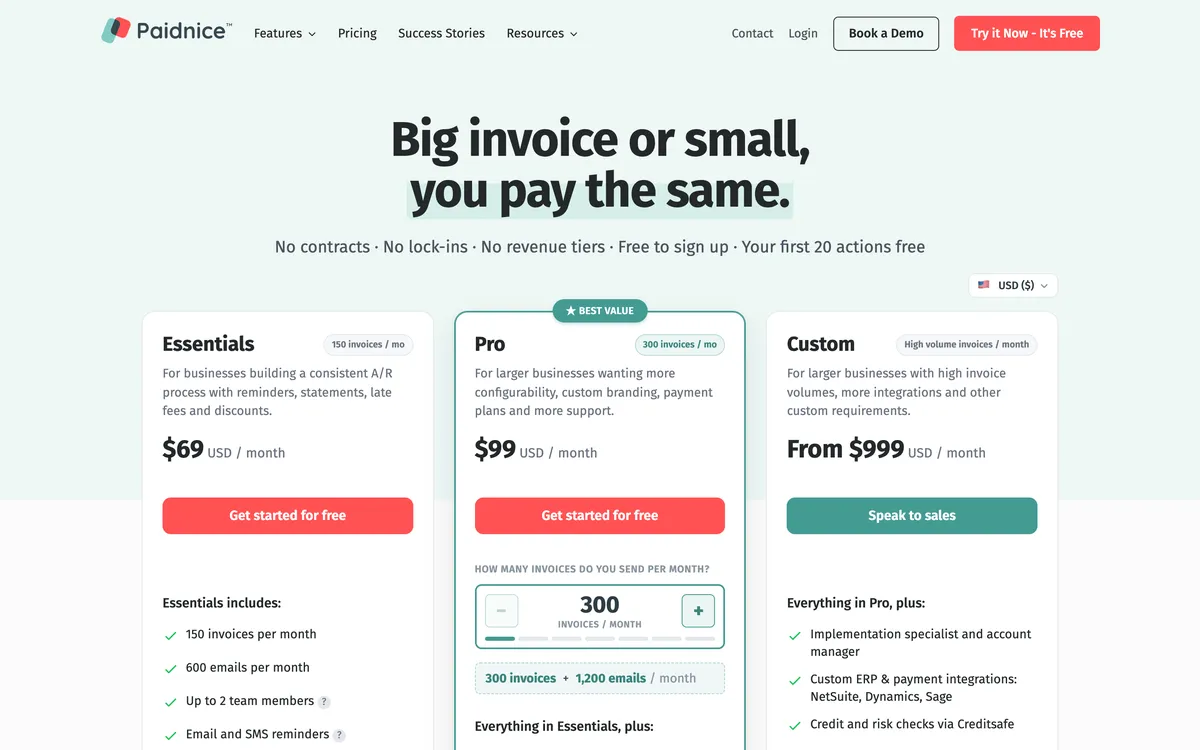
- US$69/mo on Essentials, covering 150 invoices, 600 emails and up to 2 team members; Pro from US$99/mo with unlimited users and no per-seat fee; Custom from US$999/mo. Customers are billed from a local price table rather than an FX conversion, so Essentials is £49, A$99, €59, C$89, NZ$109 excluding GST, or R1,100.
- Rated
- 5.0 from 83 Xero App Store reviews; 4.9 from 14 on Capterra · Xero App Store listing
- Awards
- Winner, New Zealand Small Business App of the Year, Xero Global App Awards 2026; 2025 Xero Global Small Business App of the Year
- Runs on
- Xero, QuickBooks Online, Stripe, Pinch Payments, CloudDepot, HubSpot, Pipedrive, Zapier. NetSuite, Sage Intacct, MYOB and Dynamics 365 Business Central on the Custom plan only
- Late fees and interest
- Yes. Flat, percentage and compounding charges, with a Bank of England base rate toggle for UK invoices, raised on the ledger as Draft or Approved. Policies sit under customer groups, so several run at once
- Does best
- Two charge types on the same customer group, an invoice late fee and a statement interest charge, both posted to the ledger
Paidnice costs about $29 a month more than AR Collect’s QuickBooks Online entry price, and the second charge type is what the difference buys.
An invoice late fee runs per overdue invoice and a statement interest charge runs on the whole overdue balance, both available on the same customer group, both raised on the ledger as a posted invoice, Draft or Approved.
That posting is the mechanism: only a document on the ledger enters the customer’s own payables, their aged payables report and their next payment run.
The rest of the gap is channel and schedule. Reminders go by email from your own authenticated domain and by SMS metered at $0.10 a message. Statements run on any schedule you set, including consolidated parent and child accounts.
Payment plans take deposits, installments and auto-pay through Stripe and Pinch Payments, and an account on a plan comes off the fee policy while the reminder ladder keeps running. Prompt payment discounts, escalations and two-way SMS replies sit alongside. Customers can also query an invoice or submit a promise to pay from the portal.
The interest figure is calculated when the statement goes out rather than when the policy last ran, so a customer who part-paid yesterday sees today’s balance rather than last week’s, less any credit sitting on the account. Compounding runs unless you switch it off.
Paidnice uses AI to read customer replies, draft responses, log payment promises and find the reason behind a dispute. A person approves each draft before it sends, unless you pre-approved that action type. It also has an MCP server on Pro and Custom plans, so Claude, ChatGPT or any agent that takes a custom connector can work with your organizations. AR Collect has no AI of any kind.
Limitations with Paidnice. There is no QuickBooks Desktop connector of any kind, which rules it out entirely for a Desktop business and is the only Paidnice limitation that decides this page.
It is native to Xero and QuickBooks Online; NetSuite, Sage Intacct, MYOB, Dynamics 365 Business Central and other cloud ERPs connect on the Custom plan, and some payment features differ between the two ledgers.
The entry tier covers two team members, and the entry price is about $29 a month above AR Collect’s.
Best suited for: Xero or QuickBooks Online businesses whose scheduled reminders are being ignored and who want the next step to cost the customer something. The drawback is that there is no QuickBooks Desktop connector.
2. AR Collect

Best for: A QuickBooks Desktop business that has been priced out of this category entirely, from $39.95 a month ($49.95 on Desktop).
What is AR Collect best for?
For a small business whose ledger nothing else in this category will read, and whose budget for solving that is under fifty dollars a month.
- Fits
- Small businesses on QuickBooks Desktop, QuickBooks Online or Xero. No revenue band is published; the price band is set by how many invoices are open, starting at 500
- Regions
- United States. The vendor publishes no company details, and support is answered on a New York area number. The Xero App Store listing was added in April 2025
- Entry cost
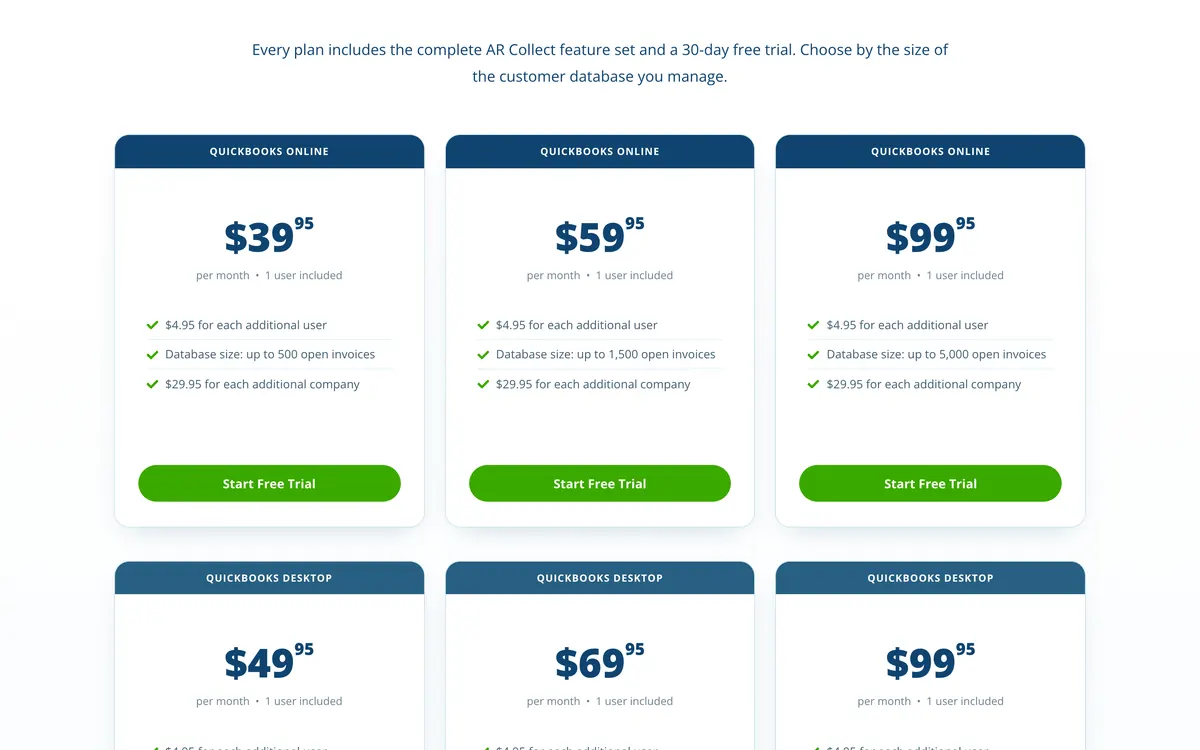
- $39.95/mo for up to 500 open invoices, $59.95/mo for up to 1,500 and $99.95/mo for up to 5,000 on QuickBooks Online; $49.95, $69.95 and $99.95 on QuickBooks Desktop; $199.95/mo for up to 10,000 on the Massive Database plan covering both. Xero is $39.95/mo for unlimited invoices on the vendor site. Each plan includes one user. Extra users are $4.95/mo and extra companies $29.95 on QuickBooks Online or $35.95 on QuickBooks Desktop. Annual billing is offered at a discount with no figure published. A 30-day trial runs with no card. Check current pricing with the vendor.
- Rated
- 4.0 from 2 reviews on G2, both February 2022; 5.0 from 1 review on Capterra, December 2022; 2 reviews on Trustpilot, both posted 28 April 2026; no reviews yet on its Xero App Store listing · Xero App Store listing
- Awards
- None found
- Runs on
- QuickBooks Online, QuickBooks Desktop Pro, Premier and Enterprise through the Web Connector, Xero
- Late fees and interest
- None found. Late fees and interest are not mentioned anywhere in the vendor’s materials
- Does best
- QuickBooks Desktop coverage for Pro, Premier and Enterprise, which almost nothing else in the category reaches
QuickBooks Desktop reach is the reason to consider AR Collect. AR Collect connects to QuickBooks Desktop Pro, Premier and Enterprise through the Web Connector.
Nothing else compared on this site reaches Desktop at all, so for a business still running it the shortlist is one item long and it costs $49.95 a month.
The product itself is narrow by design. Invoices sync in from the ledger, customers are placed in groups, and each group is linked to a template series and a schedule that sends advance reminders before the due date and past-due notices after it.
A bulk smart email goes to every past-due customer behind a filter, replies are tracked back against the customer, and statements run daily, weekly or monthly with the invoice PDFs attached. Card and ACH payments run through a portal with a surcharging option, and the vendor adds no card fee of its own on any gateway.
In place of a payment plan there is a promise to pay: an amount and a date captured against the customer, listed on commitment reports over a date range, flagged on exception reports when the date passes unpaid, embedded in the reminder email so the customer sees their own commitment quoted back, and fed into cash flow forecasting.
The promise-to-pay record is useful, and the section below sets out how it differs from a schedule of money.
Limitations with AR Collect. No late fees and no interest of any kind, no SMS, no payment plan beyond a promise-to-pay record, and no AI anywhere in the product. Five public reviews exist in total: three from 2022 and two on Trustpilot posted the same day in April 2026, so there is little evidence of how it performs at volume.
There is no public API and cash application is not documented. The vendor publishes no company details at all. Pricing is published up to 10,000 open invoices, and each extra user and each extra company is charged on top.
Best suited for: QuickBooks Desktop businesses that want scheduled email reminders and statements for under $50 a month. The drawback is no late fees, no SMS, no payment plans and only five public reviews.
How does a promise to pay differ from a payment plan?
Both products have something in the space between “pay it all now” and “we will chase again next week”, and the two things are not the same product.
An AR Collect promise to pay captures an amount and a date. Commitment reports list what was promised over a date range, exception reports show what was missed, the promise is embedded in the reminder email so the customer sees their own commitment quoted back to them, and the figure feeds cash flow forecasting.
What it does not do is move money. When the date passes, the follow-up lands on a person.
A Paidnice payment plan is a schedule with money against it. Deposits, installments and auto-pay run through Stripe or Pinch Payments, the dates exist as collections rather than as reminders, and the account comes off the fee policy while the reminder ladder keeps running.
The record is useful and cheap to build, which is why the cheaper product has it. If your customers keep their promises, the record is enough. If they do not, an exception report tells you the date passed, while an auto-pay run collects the money on it.
A payment plan is also not the same product as invoice finance. An installment plan leaves the receivable and the credit risk with you; a finance provider settles the invoice in full and carries the risk itself. Neither tool on this page does the second thing.
How do Paidnice and AR Collect compare side by side?
Both sync from the ledger, both send scheduled reminders, both issue statements and both take payment through a portal. Read the ledger, late fee and payment plan rows; the rest largely agrees.
|
|
|
|---|---|---|
| Best for | Xero or QuickBooks Online teams adding fees, SMS and plans | QuickBooks Desktop businesses wanting email reminders under $50 a month |
| Revenue fit | Any size up to $50m a year, or 50,000 invoices a year | Not published. Bands are set by open-invoice count, from 500 |
| From (monthly) | $69 | $39.95 (QuickBooks Online, Xero); $49.95 (QuickBooks Desktop) |
| Priced on | Invoice volume, no per-seat fee | Open invoice count, plus $4.95 per extra user and a charge per extra company |
| Ledger integrations | Xero, QuickBooks Online. NetSuite, Sage Intacct, MYOB and Dynamics 365 Business Central on the Custom plan only | QuickBooks Online, QuickBooks Desktop Pro, Premier and Enterprise through the Web Connector, Xero |
| Late fee grain | Yes (per customer group) | None found |
| Chasing channels | Email from your own authenticated domain, SMS metered at $0.10 with two-way replies, in-app calls on Pro and above, recorded and transcribed | Email only, advance and past-due, scheduled per customer group |
| Statements | Yes (any schedule, consolidated parent accounts) | Yes (daily, weekly or monthly, invoice PDFs attached) |
| Payment plans | Yes (deposits, installments, auto-pay) | None found (promise to pay only) |
| Portal | Yes (pay-now links, Stripe and Pinch Payments) | Yes (card and ACH, surcharging option) |
| AI | Yes (Paidnice says it reads replies and drafts the answer; a person approves) | None found |
| AI | Advanced Reads customer replies, drafts answers and follow-up actions (like PO updates) for your approval; MCP server for Claude, ChatGPT and other agents | None No AI feature found |
| Rated (source, count) | 5.0 (83, Xero App Store) | 4.0 (2, G2); 5.0 (1, Capterra); 2 reviews (Trustpilot, April 2026) |
“Not documented” means the vendor does not document the capability. “Not published” means the vendor does not print a price. “None found” means no evidence either way. Prices are the vendor’s published from-price.
Are five reviews enough evidence to trust AR Collect?
AR Collect publishes a price and almost nothing else. Its entire public evidence base is five reviews.
4.0 from 2 reviews on G2, both February 2022. 5.0 from 1 review on Capterra, December 2022. 2 reviews on Trustpilot, both posted on 28 April 2026. No reviews at all on a Xero App Store listing added in April 2025.
No company details published anywhere, and support answered on a New York area number. Set that against Paidnice’s 5.0 from 83 Xero App Store reviews, and 4.9 from 14 on Capterra.
Five lifetime reviews, two of them posted on the same day, leave little evidence about how the product behaves at volume or under load. On a two-thousand-dollar-a-month platform a base that thin would rule the product out. On a $39.95-a-month tool with a 30-day trial and no card required, it is a risk you can price.
So price it. Inside the trial you can check the five things a deeper review base would have told you.
Check whether the ledger sync pulls every open invoice, whether the advance and past-due schedules fire on the day they say, and whether replies track back against the right customer. Check also whether statements attach the invoice PDFs, and whether the pay-now portal settles to your account without the vendor adding a card fee.
Two things a trial cannot tell you: whether support answers in month eight, and whether your plan band is set by open invoices or by active customer accounts, which the pricing page states both ways.
Ask both before you migrate a live ledger.
What a US small business is actually waiting on
The gap both products are sold into, in the only figures measured across the whole US small-business ledger.
Xero Small Business Insights, June 2026. The average US small business now waits 29.1 days for payment, up from 27.5 twelve months earlier, and still settles 8.3 days past the due date. Where the business trades matters more than the average suggests: 38.7 days in New York against 24.1 in California.
A 29.1-day wait against 30-day terms looks healthy on its own. Settling 8.3 days past due means the terms are being read as a suggestion, and that average already includes every business that chases properly.
In the United States a late fee is a term of your contract rather than a statutory entitlement, so the rate and the trigger are yours to set inside what state law allows.
That makes the grain of the software the whole question: how soon a charge fires, how often it repeats, and whether it can differ between one customer and another. AR Collect answers none of the three, because it computes nothing. Paidnice answers all three at customer-group grain.
- AR Collect
- None found. Any late fee or interest charge has to be raised manually in QuickBooks or Xero.
- Paidnice
- An invoice late fee and a statement interest charge, both available on the same customer group, both posted to the ledger as Draft or Approved, with compounding on by default.
Where each one runs out: volume, channels and charges
AR Collect on 900 open invoices, with 3 users and 2 QuickBooks Online companies, costs $99.80 a month. Three users put Paidnice on Pro, from $99 a month with unlimited users.
Neither vendor prices on revenue. AR Collect bands on how many invoices are open at once and Paidnice bands on how many you raise in a month, and both stop at a point worth knowing before you commit.
AR Collect publishes $39.95 to 500 open invoices, $59.95 to 1,500 and $99.95 to 5,000 on QuickBooks Online ($49.95, $69.95 and $99.95 on Desktop), and $199.95 to 10,000 on its Massive Database plan.
Above 10,000 no price is printed, and the plan moves up a band automatically as open invoices accumulate. There is no public API, cash application is not documented, and there is no AI anywhere in the product.
Paidnice runs $69 at 150 invoices a month, $99 on Pro at 300, $179 at 600, $799 at 4,000, and from $999 on Custom, quoted for an ERP connection at any volume, billed from a fixed local price table rather than an FX conversion so Essentials is £49, A$99, €59, C$89, NZ$109 excluding GST or R1,100.
It runs out at the ledger rather than at the volume: no QuickBooks Desktop.
Add-ons are what move AR Collect’s bill past the headline. On 900 open invoices with 3 users and 2 QuickBooks Online companies, the plan is $59.95 and the add-ons are $39.85, so the real figure is $99.80 a month. Three users put Paidnice on Pro, from $99 a month with unlimited users. Set your own numbers below.
On 900 open invoices with 3 users and 2 QuickBooks Online companies, AR Collect’s plan is $59.95 and the add-ons are $39.85, so the bill is $99.80 a month.
AR Collect’s published QuickBooks Online tiers are $39.95 to 500 open invoices, $59.95 to 1,500 and $99.95 to 5,000, with $199.95 to 10,000 on the Massive Database plan and no price printed above that. Desktop tiers are $49.95, $69.95 and $99.95.
Each plan includes one user and one company; extra users are $4.95 and an extra QuickBooks Online company is $29.95, or $35.95 on QuickBooks Desktop. Paidnice includes two users on Essentials and unlimited users on Pro and Custom, and charges $29 per extra entity. Verify both with the vendor before you buy.
Which accounts receivable software fits your use case?
Start from the ledger, then from what happens when a reminder is ignored. Users and companies change the AR Collect bill, so price those too.
| Use case | Start with | Why |
|---|---|---|
| Ledger is QuickBooks Desktop | AR Collect | Connects through the Web Connector; Paidnice has no Desktop connector. |
| Email reminders and statements only, one user, under $50 a month | AR Collect | $39.95 on QuickBooks Online or Xero, with a 30-day trial that takes no card. |
| Reminders being ignored on Xero or QuickBooks Online | Paidnice | An invoice late fee and statement interest, posted to the ledger. |
| Customers who need installment plans | Paidnice | Deposits, installments and auto-pay; AR Collect records a promise to pay only. |
| SMS as a second channel | Paidnice | SMS metered at $0.10 a message; AR Collect chases by email only. |
| Statements across parent and child accounts | Paidnice | Consolidated statements on any schedule; AR Collect runs statements daily, weekly or monthly. |
Questions from QuickBooks businesses pricing this pair
The questions that come up when the two prices are close enough that the decision turns on what is missing rather than what is included.
We are on QuickBooks Desktop. Is there a decision to make?
Not between these two. AR Collect connects to QuickBooks Desktop Pro, Premier and Enterprise through the Web Connector, and Paidnice has no Desktop connector at all. Both connect to QuickBooks Online and to Xero, so the decision only opens up once you are off Desktop.
Does AR Collect apply a late fee?
No. Late fees and interest are not mentioned anywhere in its public materials, so any charge has to be raised manually in the ledger. Paidnice applies an invoice late fee and a statement interest charge, both available on the same customer group, and posts each one as a Draft or Approved invoice.
What does AR Collect cost with three users and two companies?
On 900 open invoices on QuickBooks Online it is $59.95 for the plan plus $39.85 of add-ons, so $99.80 a month. Each plan includes one user and one company, extra users are $4.95 and an extra QuickBooks Online company is $29.95.
Should five reviews put me off?
Not on its own, at this price. Five lifetime reviews, three from 2022 and two posted on the same day in April 2026, give little independent evidence of how the product behaves at volume, which matters more the more you are spending.
The 30-day trial takes no card, so most of what the reviews would have told you can be checked yourself in a fortnight.
Is a promise to pay enough instead of a payment plan?
It is if your customers keep their promises. A promise to pay is an amount and a date on a report, with the follow-up landing on a person when the date passes. A payment plan is deposits, installments and auto-pay collected on the dates themselves.
Does either one send SMS?
Only Paidnice, metered at $0.10 a message, alongside email sent from your own authenticated domain. AR Collect chases by email only.
What happens as open invoices grow?
The AR Collect plan moves up a band automatically: $59.95 to 1,500 and $99.95 to 5,000 on QuickBooks Online, then $199.95 to 10,000 on the Massive Database plan. Above 10,000 no price is published, so past that point the comparison against Paidnice’s published tiers cannot be made from public materials.
If Desktop is not the constraint
Comparison
AR Collect vs Biller Genie
Two QuickBooks-first tools on price, late fees and payments.
Buyer's guide
Best AR software for QuickBooks
Compared for QuickBooks Online and QuickBooks Desktop businesses.
Buyer's guide
Best accounts receivable software
The pillar guide, compared by business size and accounting system.
Resource
How much can I charge in late fees?
What a late fee can be, and what makes one enforceable.
Sources
6 sources, checked by Julie Turnbridge on October 26, 2026
- Xero App Store apps.xero.com/app/paidnice
- Capterra capterra.com/p/254868/Paidnice
- G2 g2.com/products/arcollect/reviews
- Capterra capterra.com/p/233202/AR-Collect
- Xero App Store listing apps.xero.com/us/app/ar-collect
- Xero Small Business Insights xero.com/us/resources/small-business-insights