The five best debt collection software tools for small business in 2026 are Paidnice, Chaser, Biller Genie, ezyCollect and AR Collect. Paidnice is our #1 pick for a small business on Xero or QuickBooks Online, of any size up to $50m a year, that wants the late fee raised on the ledger. Published entry prices run from $39.95 a month.
| Tool | Best for |
|---|---|
| Paidnice | small businesses on Xero or QuickBooks Online that want the charge raised on the ledger, any size up to $50m a year, or 50,000 invoices a year |
| Chaser | a small business with a named collector that wants every channel from one schedule, entry tier priced to £4m turnover |
| Biller Genie | a US small business where card and ACH volume is the real workload, under $20m |
What debt collection software for small business is (and what it is not)
Debt collection software for a small business works the aged receivables ledger of invoices the business raised itself: it chases each overdue balance, raises a charge, offers a way to settle and documents the last step.
- Chases: email and SMS sequences that harden as a balance moves from 30 to 60 to 90 days.
- Charges: in Paidnice, Chaser and Biller Genie, a late fee or interest charge on the invoice.
- Settles: a portal that takes a card or bank payment, or starts an installment plan.
- Records: promises to pay and a dated log of every contact, the one item an agency asks for that only the software holds.
- Escalates: a demand letter or an agency referral, documented in Chaser and ezyCollect.
It sits on the ledger. All five tools here read Xero and QuickBooks Online, and AR Collect and Biller Genie also reach QuickBooks Desktop, so a part payment stops the wrong message going out.
It is not agency software. Platforms such as Katabat, Quantrax and Collect! run caseloads of debt other companies originated, with dialler, commission and compliance machinery a first-party creditor does not need.
It is not a collection agency or invoice finance either. An agency takes a share of what it recovers, and a finance provider settles the invoice and carries the risk; the software keeps the debt, and the decision, with you.
How this list was put together
This list helps a small business chase the overdue invoices it raised itself, before it needs a collection agency.
| What we checked | Where the evidence came from |
|---|---|
| Late fees and interest raised on the ledger | Vendor help pages on fees and interest |
| Escalation to a collection partner | Vendor product pages for referral and demand letters |
| Statements, payment plans and a portal | Vendor feature pages |
| Ledger integrations | Vendor integration pages |
| Published from-price | The vendor's pricing page, and the last reported price where it is now hidden |
| Rating and review count | The Xero App Store, Capterra or G2 |
What is the best debt collection software for a small business?
It depends on your ledger and on what you need after the reminder. Paidnice fits a Xero or QuickBooks Online business that wants a late fee or interest charge on the ledger per customer group. Chaser fits a named collector who wants every channel on one schedule.
Biller Genie fits US card and ACH volume. ezyCollect fits a trade ledger that needs demand letters and agency referral. AR Collect has the lowest published price and covers QuickBooks Desktop Pro, Premier and Enterprise.
Related guides: the pillar guide to accounts receivable software, AR software for debt collection agencies, how much you can charge in late fees
On Xero Small Business Insights data for June 2026 a US small business waits 29.1 days to be paid and settles 8.3 days past due, and the wait has lengthened by 1.6 days on the 27.5 days recorded a year earlier.
Those are the averages a healthy ledger runs at. Collection starts where an account stops behaving like the average, and a New York payer sits more than half as long again from the invoice date as a California one before that judgement is even fair.
Agency case-management platforms, consumer collections tools and debt purchase marketplaces are excluded, and the remaining tools are compared on segment fit, whether they raise a late fee or interest charge, published entry price, verified rating and ledger coverage.
You are a first-party creditor, not a collection agency
Search the phrase and half of what comes back is built for agencies: caseload management, diallers, commission splits and compliance workflows for debt somebody else originated. If the invoices are ones your own business raised, none of that is your product, and the difference is legal as well as commercial.
A business chasing its own invoices in its own name is a first-party creditor.
In the United States the Fair Debt Collection Practices Act regulates third-party debt collectors rather than a creditor pursuing its own accounts, although several states extend their own rules to first-party collection and consumer debt carries obligations that commercial debt does not, so check your state before you write a policy.
The practical consequence is that the compliance machinery agency platforms are built around solves a problem you do not have, and you pay for it anyway.
What you do have is an aged receivables ledger, a customer you may still want to sell to next year, and a decision to make about every balance on it. The five tools below all sit on that ledger. Agency platforms such as Katabat, Quantrax and Collect! run the other job entirely.
Two further names surface on this search and neither is listed here. InvoiceSherpa is positioned as a low-cost reminder and recurring-collection app; Gaviti is an invoice-to-cash platform aimed at mid-market and enterprise AR teams.
Neither publishes enough verifiable pricing, feature behavior or review evidence to place against the five. Tools whose AI drafts or runs the chase itself are compared in the AI collections software guide.
What a first-party creditor actually needs from the software:
- A sequence that hardens with age. Scheduled follow-ups by email and SMS, before and after the due date, with the wording and the cadence changing as the balance moves from 30 to 60 to 90 days.
- A live link to the ledger holding the debt. Two-way sync with Xero, QuickBooks or Sage, so a part payment on day 70 stops the wrong message going out on day 72.
- A charge you can raise and then trade away. A late fee or interest posted to the ledger, which gives you something to waive in exchange for the money.
- A way for the debtor to settle without speaking to you. A page that shows the invoice, downloads a statement, takes a card or bank payment, or starts an installment plan.
- A documented last step. A formal demand, an exportable case pack or a referral, so a balance you have given up on does not simply age on the ledger.
At 90 days a seventh reminder changes nothing. A charge raised as a document enters the customer's payables queue, which is the first step in the sequence their finance team has to process rather than read.
The five tools compared
Two rows decide most shortlists here. Late fees and interest says whether you have anything to trade at 60 days. Escalation to collection says what exists after you stop, and ezyCollect is the only tool on the list with a referral path documented inside the product.
 |
 |
Biller Genie |  |
AR Collect | |
|---|---|---|---|---|---|
| Best for | Xero or QuickBooks Online, with the charge raised on the ledger | A named collector wanting every channel and agency referral | US card and ACH volume, under $20m | Trade ledgers needing demand letters and agency referral | One-person desks and QuickBooks Desktop, under $10m |
| Revenue fit | Any size up to $50m a year, or 50,000 invoices a year | £4m and under on the entry tier, tiers to £100m | Under $20m | Not published; priced by active debtor count | Under $10m |
| From (monthly) | $69 | £199 | $49.95 plus 0.50% of invoices collected (last reported; now hidden, request a quote) | A$275 on annual billing, plus a setup fee from A$900 (last published; now hidden, request a quote) | $39.95 (QuickBooks Online, Xero), $49.95 (QuickBooks Desktop) |
| Ledger integrations | Xero, QuickBooks Online | Xero, QuickBooks, Sage, NetSuite, Dynamics 365 | QuickBooks Online, QuickBooks Desktop, Xero, AccountingSuite | Xero, MYOB, QuickBooks Online, NetSuite, Sage 300 and Intacct, SAP Business One | QuickBooks Online, QuickBooks Desktop (Pro, Premier, Enterprise), Xero |
| Late fees and interest | Yes (per customer group) | Yes (one global rule) | Yes (30-day cycle, paid add-on) | None found | None found |
| Statements | Yes (any schedule) | Yes (monthly, fixed day) | Yes | Yes (monthly) | Yes (daily, weekly or monthly) |
| Payment plans | Yes | Yes | Yes (customer requests, you approve) | Yes (paid add-on) | No (promise to pay only) |
| Portal | Yes | Yes | Yes | Yes | Yes |
| Escalation to collection | None found | Yes (partner, success fees from 20%) | None found | Yes (in-app demand letters and referral to partner agencies) | None found |
| AI | Advanced Reads customer replies, drafts answers and follow-up actions (like PO updates) for your approval; MCP server for Claude, ChatGPT and other agents | None No AI features | None No AI in the product | Basic an AI email template generator as a paid add-on; Aimie is in early access | None No AI feature found |
| Rated (source, count) | 5.0 (83, Xero App Store) | 4.98 (374, Xero App Store) | 4.8 (27, Capterra) | 4.9 (35, Xero App Store) | 3 public reviews in total |
"Not documented" means the vendor does not document the behavior. "Not published" means the vendor prints no figure. "None found" means nothing in the vendor's materials points either way. Each price is the vendor's own published from-price. Check current pricing with the vendor.
1. Paidnice, best for small businesses wanting the charge raised on the ledger
Best for small businesses on Xero or QuickBooks Online that want the charge raised on the ledger, any size up to $50m a year, or 50,000 invoices a year
What is it best for?
For a small business that wants a late fee or an interest charge posted to the ledger automatically, with a different policy for each customer group.
- Fits
- Xero and QuickBooks Online businesses of any size up to $50m a year, or 50,000 invoices a year, with or without a dedicated collections person
- Regions
- United States, Canada, United Kingdom, Australia, New Zealand, South Africa
- Entry cost
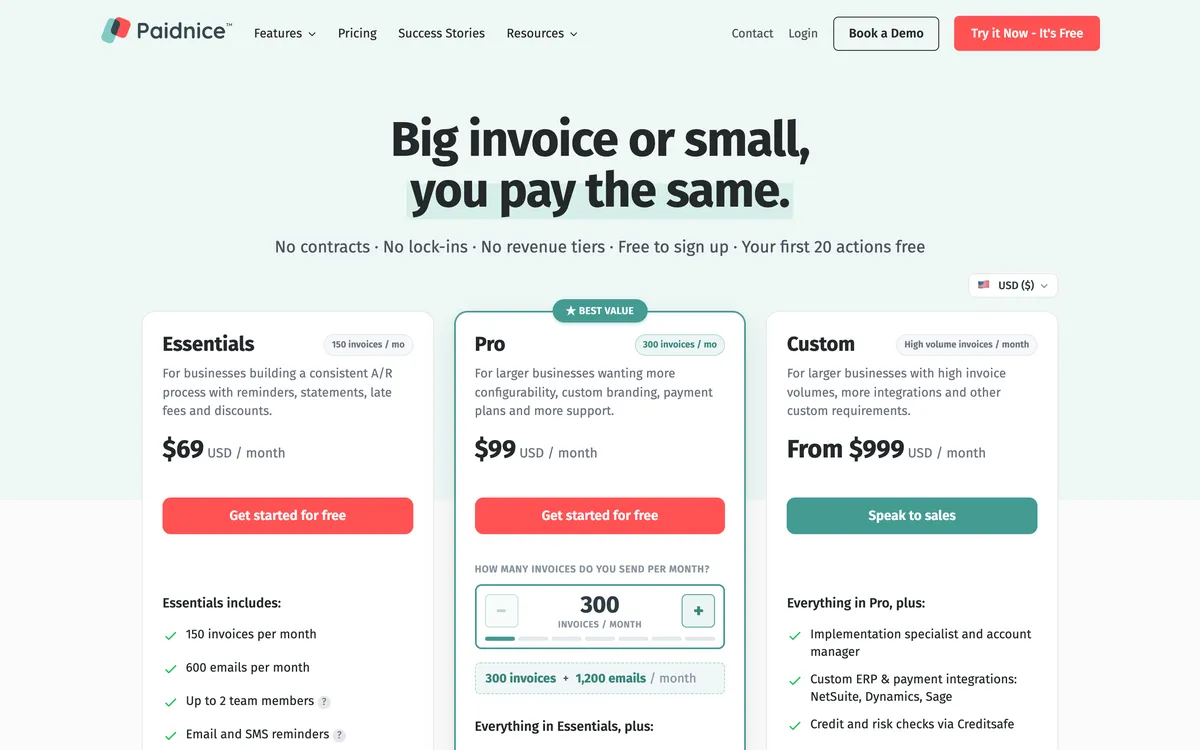
- $69/mo on Essentials, covering 150 invoices, 600 emails and up to 2 team members; Pro from $99/mo with unlimited users and no per-seat fee. Customers are billed in their own currency from a fixed local price table rather than a conversion
- Rated
- 5.0 from 83 Xero App Store reviews; 4.9 from 14 on Capterra
- Awards
- Winner, New Zealand Small Business App of the Year, Xero Global App Awards 2026; 2025 Xero Global Small Business App of the Year
- Runs on
- Xero, QuickBooks Online, Stripe, Pinch Payments, CloudDepot, HubSpot, Pipedrive, Zapier. No QuickBooks Desktop. NetSuite, Sage Intacct, MYOB and Dynamics 365 Business Central on the Custom plan only
- Late fees and interest
- Yes. Two charge types on the same customer group, an invoice late fee charged per overdue invoice and a statement interest charge against the whole overdue balance, flat, percentage or compounding, with compounding on by default
- Does best
- A different late fee policy per customer group, several of them running at the same time
Paidnice works the aged ledger in Xero or QuickBooks Online rather than a separate case list: sequences that harden as the balance moves from 30 to 60 to 90 days, statements on any schedule including consolidated parent accounts, installment plans, early payment discounts and a page the debtor can settle on without calling anyone.
Messages go by email and SMS from the business's own authenticated domain, which is what stops a 90-day letter arriving from a mailbox the customer has already filtered.
The charge lands on the ledger as a Draft or an Approved invoice, and at this end of the process that is what makes it usable. A fee held inside an app is a number on a screen.
A fee raised as a document reaches the customer's payables system with a reference on it, and at 120 days it is also part of the evidence of what you charged and when.
Statement interest is calculated at the moment the statement sends rather than at the last policy run, on the balance net of any credit on the account. Paidnice reports that customers have half as many late invoices in the first 30 days.
Limitations with Paidnice. Native to Xero and QuickBooks Online only, with no QuickBooks Desktop support, so a Desktop business cannot use it. The four heavier ledgers, NetSuite, Sage Intacct, MYOB and Dynamics 365 Business Central, are Custom-plan builds rather than standard connectors.
There is no referral route to a collection agency, so the last step of a genuine debt collection process happens outside the tool. The entry tier covers 150 invoices and two team members.
Best suited for: A small business on Xero or QuickBooks Online, of any size up to $50m a year, that wants a late fee or interest charge posted to the ledger per customer group. It has no QuickBooks Desktop support and no agency referral route.
2. Chaser, best for a small business with a named collector
Best for a small business with a named collector that wants every channel from one schedule, entry tier priced to £4m turnover
What is it best for?
For a business with someone whose job is chasing, that wants email, SMS, letters and automated calls running from one schedule, and a route into agency collection when chasing fails.
- Fits
- Businesses that already pay someone to collect; the entry tier is sized to £4m turnover and under, and the tiers run to £100m
- Regions
- UK-registered, trading since 2014, sells worldwide
- Entry cost
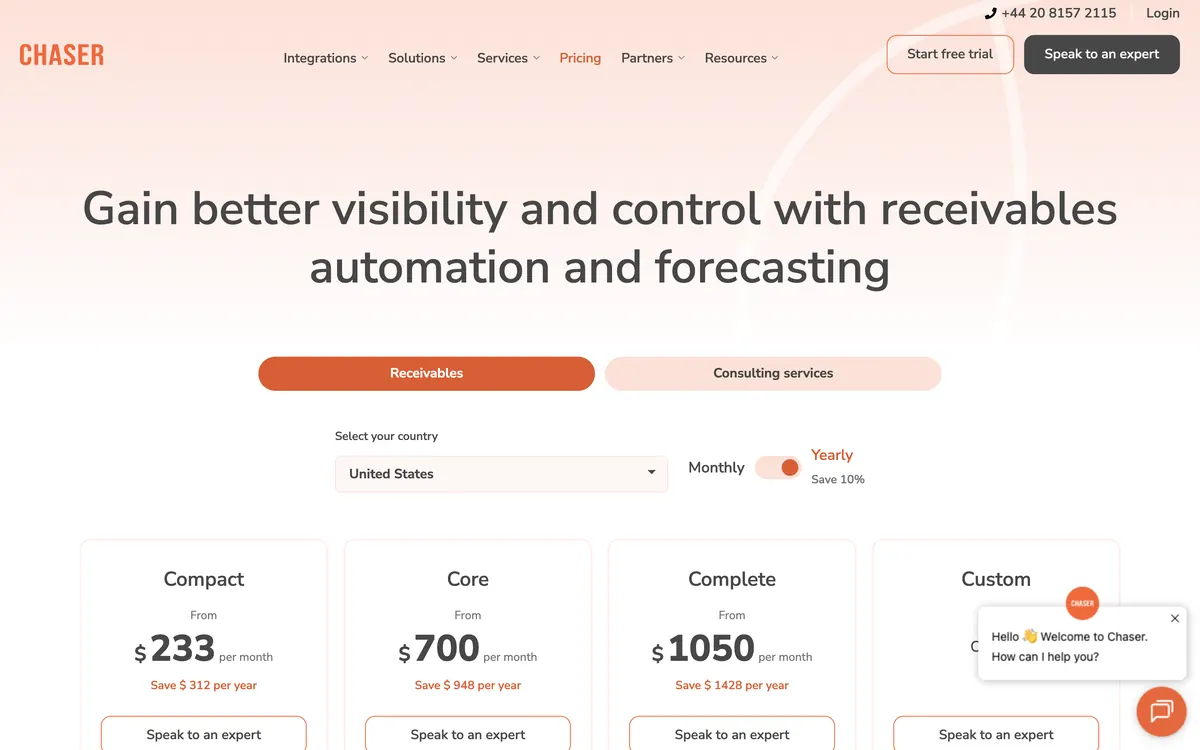
- £199/mo on Compact for turnover to £4m with 4 users; Core £599/mo to £10m; Complete £899/mo above that. Prices are in GBP excluding VAT, and a demo is required before you can buy
- Rated
- 4.98 from 374 Xero App Store reviews; 4.5 from 68 on G2; 4.9 from 45 on Capterra, though that base is mostly 2020 to 2022
- Awards
- Xero App Partner of the Year 2023
- Runs on
- Xero, QuickBooks, Sage 50, Sage 200, Sage Intacct, Sage Business Central, NetSuite, Dynamics 365, AccountsIQ, SAP, HubSpot, Gmail, Outlook
- Late fees and interest
- Yes. Four calculation types, recalculated daily, but one global rule only, which cannot vary by schedule or customer group, and no fee is raised on payment-plan or partially paid invoices. Line-item sync of the fee is Xero only
- Does best
- Multi-channel chasing, email, SMS, printed letters and an automated call, driven from one schedule, with integrated agency collection at the end of it
- Customers
- Named on its website: Pact Coffee, Huttie and TaxAssist. Huttie's case study reports £15,000 of old debt recovered.
Chaser has been in the market since 2014 and sends reminders from the team's own Gmail or Outlook mailbox, adding SMS, printed letters, a one-way automated call, a payer portal and a dispute log. Every channel except email is metered by credits, so the running cost moves with how hard you chase.
It is also the only tool here that hands a debt over inside the product. Collections run through a partner, with success fees stepping from 20% down to 6% by size in the UK and the EEA, and from 30% down to 7.5% elsewhere, plus surcharges of 8% and 15% on older debt.
UK businesses get in-app credit checking supplied by Creditsafe, carrying a credit score with a recommended limit, the customer's payment score, credit event history, and Companies House filing and director data.
Limitations with Chaser. The entry price is tiered by company turnover rather than by how many accounts you are actually working, and it rose roughly four to five times when Chaser moved off its old invoice tiers, which puts £199 a month in front of a business that may be chasing a dozen balances.
The fee engine runs a single rule across the whole ledger. Statements are monthly and land on a fixed day, which a collections desk cannot retime around an ageing account. Four users is the Compact ceiling. The credit data is a UK bureau product, so a US business is buying the chasing rather than the risk file.
Best suited for: A business with a named collector that wants email, SMS, letters and automated calls from one schedule, and a route into agency collection. The price is tiered by turnover from £199 a month, and the fee engine runs one rule across the whole ledger.
3. Biller Genie, best for US small businesses with heavy card and ACH volume
Best for a US small business where card and ACH volume is the real workload, under $20m
What is it best for?
For a US business whose collection problem is really a payments problem: getting cards and ACH accepted, surcharged correctly and reconciled back to the ledger.
- Fits
- US businesses moving real card and ACH volume on QuickBooks Online or Desktop, under $20m
- Regions
- United States
- Entry cost
- Last reported by third-party listings at $49.95/mo plus 0.50% of invoices collected, capped at $1,500/mo, with no contract; Biller Genie now hides its prices, so request a quote. The same listings last reported ACH as an add-on from $20/mo plus a $25 setup fee and $0.50 a transaction, and paper mail at $1.50 a reminder
- Rated
- 4.8 from 27 Capterra reviews; 3.0 from 4 on G2; 2.33 from 3 on its Xero App Store listing
- Awards
- None found
- Runs on
- QuickBooks Online, QuickBooks Desktop, Xero, AccountingSuite
- Late fees and interest
- Available as a paid add-on, on a fixed 30-day cycle only. An invoice is not treated as late until 30 days past due, fees then recur every 30 days and stack, and there is no interest calculation
- Does best
- A branded customer payment portal wired to card and ACH acceptance, with surcharging and dual pricing handled at checkout
Biller Genie sits between the invoice and the payment, so its contribution to a collection is making the money easy to move rather than making the debtor uncomfortable. Six reminder types cover upcoming payment, payment due, invoice updated, statement, payment overdue and upcoming late fee, with autopay on per-customer thresholds, bulk invoice grouping and failure handling behind them.
Where a 60-day balance is a customer who has simply not put a card in, that stack does more than a seventh email: named gateways including USAePay, Maverick, Sola, Authorize.Net, Elavon and PayPal, surcharging and dual pricing with their own checkout flows, a virtual terminal and check capture.
The QuickBooks Online link runs both ways, over webhooks plus a scheduled background job, and QuickBooks Desktop is reached through a separate connector.
Limitations with Biller Genie. Biller Genie pushes its own merchant services, though its site and docs say you can connect your own gateway, and on the last reported pricing part of the price is a percentage of every dollar recovered.
Reminder timing is one global cadence with no per-customer variation, and there is no SMS. Late fees are an add-on locked to a 30-day cycle with no interest, so an invoice 29 days past due is not late at all.
There is no credit checking, no dispute module and no agency route, so everything at the 120-day boundary is yours to arrange. Reviewers report sync delays, and one Xero App Store reviewer reports a duplicate-charge fault.
Best suited for: A US business whose collection problem is really a payments problem: getting cards and ACH accepted, surcharged and reconciled. It has no SMS, no credit checks and no agency route, and late fees are an add-on on a fixed 30-day cycle.
4. ezyCollect, best for wholesale or trade ledgers wanting demand letters
Best for a wholesale or trade ledger that wants demand letters and agency referral in the same tool, priced by debtor count
What is it best for?
For a wholesale, distribution or trade business with hundreds of accounts on credit, that wants credit screening at the front and a letter of demand at the back.
- Fits
- Trade and distribution businesses carrying hundreds of accounts on credit. No revenue band published; the entry plan covers 200 active debtors, 3 users and 1 workflow
- Regions
- Australia and New Zealand first, with United States ACH and international ERP coverage; part of Sidetrade since October 2025
- Entry cost
- A$275/mo on ezyStart with a one-off setup fee from A$900; ezyGrow A$950; ezyScale A$2,350; ezyUltimate on quote, with setup up to A$3,900. Those are annual-billing rates and monthly billing adds 20%. A payment gateway fee of A$90/mo and in-app demand letters at A$49 each sit on top. Last published; ezyCollect now hides its pricing, request a quote.
- Rated
- 4.9 from 35 reviews on its Xero App Store listing; 4.7 from 25 on G2; 4.9 from 12 on Capterra, a base that is thin and mostly pre-2024
- Awards
- None found
- Runs on
- Xero, MYOB AccountRight, Exo, Essentials and Acumatica, QuickBooks Online, NetSuite, Dynamics, Sage 300 and Intacct, SAP Business One, Pronto Xi, Attaché, JCurve, ABM, CSV
- Late fees and interest
- None found. No late fee or interest mechanic appears anywhere in the help center or the relaunch material; card surcharging is the only charge it adds
- Does best
- The full escalation ladder in one place: credit screening on external bureau data, then in-app demand letters, then referral to a partner collection agency
- Customers
- Named on its website: Feral Brewing, Hampers with Bite and Skillinvest. Feral Brewing's case study reports overdue accounts cut by over 50%.
ezyCollect is the tool on this list that goes furthest past the reminder. Credit Insights scores a customer from your own aged trial balance and terms plus external bureau data, and groups customers by risk. Workflows run a pre-reminder and a set of follow-up steps (six in the help center's example) by email, letter, SMS, fax and call task, consolidated per customer rather than per invoice.

At the end of the ladder sit demand letters raised inside the app at A$49 each, and a referral to a partner agency at a commission from 25% of what is recovered. Payment runs through a hosted hub with cards, wallets, direct debit and ACH, and cash is applied back to the ledger.
Limitations with ezyCollect. No late fee or interest function of any kind, so the charge that makes late payment cost something is a manual job. Pricing is by active debtor count with a setup fee, and monthly billing adds 20%, which makes the real first-year cost hard to compare against a flat monthly price.
SMS, mail and fax are charged on top of the subscription, and payment plans are a paid add-on. Customers who fall past the end of a workflow window get no further automated follow-up. The review base is thin and mostly predates 2024, and one reviewer reports a quoted price well above the advertised one.
Best suited for: A wholesale, distribution or trade business with hundreds of accounts on credit that wants credit screening and a letter of demand in one tool. It has no late fee or interest function, and pricing by debtor count with a setup fee makes the first-year cost hard to compare.
5. AR Collect, best for a one-person desk or QuickBooks Desktop
Best for a one-person collections desk, and for any business still on QuickBooks Desktop, under $10m
What is it best for?
For a single collector, or a small in-house team, working the ledger every day on the cheapest published price in the category.
- Fits
- A single collector or a small in-house team working the ledger daily, under $10m
- Regions
- United States
- Entry cost
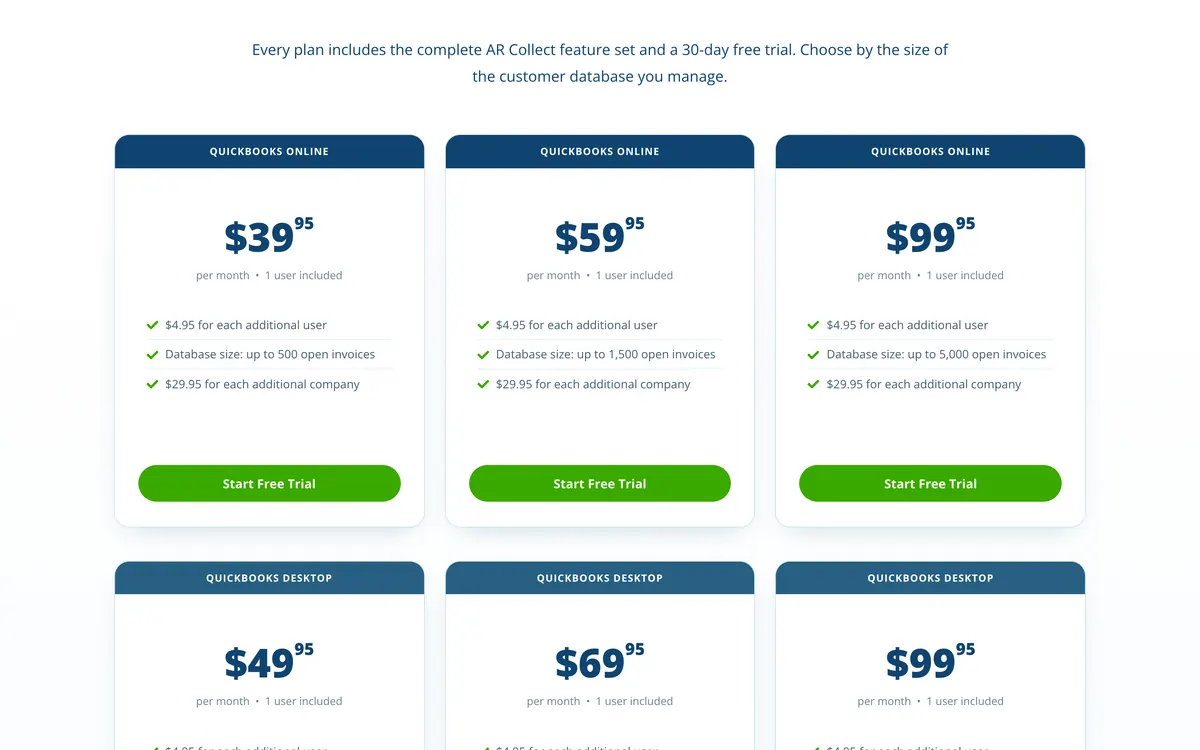
- $39.95/mo for 500 open invoices on QuickBooks Online ($49.95 on QuickBooks Desktop); $59.95 for 1,500 ($69.95 Desktop); $99.95 for 5,000 on either; $199.95 for 10,000 across QuickBooks Online and Desktop. Xero is a $39.95 special offer for unlimited invoices on the vendor site. Extra users $4.95 each, extra company $29.95 (QuickBooks Online) or $35.95 (Desktop). A 30-day unrestricted trial with no card
- Rated
- A thin base: 4.0 from 2 (2022) on G2 and 5.0 from 1 on Capterra (2022), plus 2 Trustpilot reviews from April 2026. Its Xero App Store listing has no reviews yet
- Awards
- None found
- Runs on
- QuickBooks Online; QuickBooks Desktop Pro, Premier and Enterprise through the Web Connector; Xero, listed April 2025
- Late fees and interest
- None found. No late fee, interest, SMS or payment plan function appears anywhere in its materials
- Does best
- QuickBooks Desktop Pro, Premier and Enterprise through the Web Connector, alongside QuickBooks Online and Xero
AR Collect is a workspace rather than an engine. Customers sit in groups, each group linked to a template series and a schedule, with advance reminders and past-due notices triggered by days overdue, plus a bulk send to every past-due customer with filters. Statements go daily, weekly or monthly with the invoice PDFs attached.
Promises to pay are the central record, which on a collections desk is the right thing to build around: capture the amount and the date, pull commitment reports by date range, pull exception reports on the promises that were broken, and feed both into a cash flow forecast.
Card and ACH run through the portal, with surcharging available and no card fee added by the vendor.
Limitations with AR Collect. No late fees or interest of any kind, no SMS, no installment plans and no cash application. Five public reviews across G2, Capterra and Trustpilot, two of them from April 2026, which is too small a base to read as a quality signal.
The vendor publishes no company information at all, so founders, headquarters and funding are unknown. There is no API and no escalation path beyond the reminder.
Best suited for: A single collector or small in-house team, including any business still on QuickBooks Desktop, that wants the cheapest published price. It has no late fees, SMS, installment plans or API, and only five public reviews.
When software stops working and you instruct someone
Everything above automates the cheap part of collection. The expensive decision is the one no tool makes for you: whether this balance stays inside your own process or leaves it.
Four tests, in this order. They are quick, and between them they resolve most of an aged ledger.
- How old is it? Under 60 days a balance is usually a process failure: a lost invoice, a purchase order mismatch, an approver on leave. Past 90 the reason has normally changed, and past 120 the customer has made a decision about you rather than about the paperwork.
- Has the customer responded at all? A debtor who disputes, part-pays or asks for time is still inside your process, and a plan is the next move. Silence across three channels is the signal that automation has run out of moves.
- Does the balance clear the cost of pursuing it? An agency takes a share of what it recovers, a court claim carries a fee and your own time, and both come off the top before anything reaches your bank. Small balances are often worth more written off and used to close the account cleanly.
- Do you intend to keep trading with them? This is the test people skip. Instructing a third party ends the working relationship in practice whatever the covering letter says, so where next year's revenue is worth more than this balance, the answer is a settlement rather than an instruction.
The settlement move, before the instruction
An installment plan is the last step inside your own process and it recovers more balances than further reminders do. Paidnice, Chaser, Biller Genie and ezyCollect all schedule installments against an open invoice. AR Collect records a promise to pay instead, which is a note about intent rather than a schedule that collects itself.
The shapes differ enough to matter at this stage. Biller Genie has the customer request a plan through the portal and the merchant approve or reject it, which puts a person in the loop on each one. ezyCollect offers subscription, fixed-amount and fixed-count installments, but support has to switch the feature on for your account first.
A plan is a concession on your own receivable, so the credit risk stays where it is, which is what separates it from invoice finance, where the provider settles in full and carries the risk itself.
What an instruction actually costs
Commission is charged on what is recovered rather than on what is owed, and it steps with the size and the age of the debt. Two schedules are documented on this page.
Chaser's partner charges success fees from 20% down to 6% by size in the UK and the EEA, and from 30% down to 7.5% elsewhere, with surcharges of 8% and 15% on older debt. ezyCollect refers to partner agencies at a commission from 25% of what is recovered, with an in-app demand letter at A$49 before that.
A court claim is the other route.
In England and Wales, Money Claim Online charges an issue fee scaled to the value claimed, and a further hearing fee if the claim is defended and allocated; both are published by HM Courts and Tribunals Service, both are paid up front, and both are recoverable from the debtor if you win and they pay.
A judgment is not a payment, which is the part worth understanding before you file.
Set against those numbers, an old balance is a simple comparison: 75% of a recovery against 100% of a write-off. What the software above decides is how few balances ever reach that comparison.
What each tool does at the boundary
Three questions at the handoff. Does the tool produce a formal demand, can it export a case pack, and can it refer the debt without you leaving the product.
- Paidnice stops at the charge. Bureau credit checks run on the Custom plan only, with native credit checks from payment behavior on every plan, and there is no referral route, so the formal end of a collection process happens outside the tool.
- ezyCollect is the only one with a documented referral path. Demand letters are raised inside the app at A$49 each, and referral goes to partner agencies at a commission from 25% of what is recovered. Credit Insights scores the account from your own aged trial balance plus external bureau data before any of that.
- Chaser hands the debt to a partner rather than working it in the product, on the success-fee schedule above, with a payer portal and a dispute log sitting behind it.
- Biller Genie and AR Collect stop at the reminder. Neither documents a demand letter, a dispute module or an agency route, so the case pack is whatever you can pull out of the ledger yourself.
On the case pack itself, an agency or a solicitor will ask for the invoice, the terms the customer accepted, the delivery or acceptance evidence, a full statement of account including any fee or interest raised, and a dated log of every contact attempt.
That log is the one item only the software holds, which is the strongest argument for turning the sequence on long before the balance is old enough to instruct.
What each tool charges the debtor
Paidnice and Chaser compute and raise the charge themselves. Biller Genie sells it as a paid add-on locked to a 30-day cycle. ezyCollect and AR Collect document nothing, so on those two the charge is a manual journal or it does not exist.
In the United States a late fee is a matter of contract and of state law rather than a national statutory rate, so what you may charge comes from your own payment terms and from the ceiling in your state.
The arithmetic is the same everywhere: the overdue amount multiplied by the annual rate, apportioned over the days it was late, plus any flat administration fee your terms already allow for.
On a collections desk the charge is worth more as something to give up than as something to collect. A fee sitting on the customer's ledger can be waived deliberately, in writing, in exchange for payment this week. A fee that exists only inside your own software gives you nothing to trade with.
Grain is what decides that on a mixed ledger. Chaser's fee is one global rule that cannot vary by schedule or customer group, and it raises no fee on payment-plan or partially paid invoices, so an account you intend to keep and an account you intend to escalate are treated identically.
Paidnice's policies sit under customer groups, so the accounts heading for instruction can carry a harder rule than the ones you are still selling into, and an invoice late fee and a statement interest charge can run together on the same group.
Biller Genie treats an invoice as not late until 30 days past due, then charges every 30 days after that with no interest calculation behind it.
One global rule (Chaser)
- Four calculation types
- Recalculated daily
- One rate for every customer
- No fee on payment-plan or part-paid invoices
A policy per customer group (Paidnice)
- Flat, percentage or compounding, per period
- Multiple policies running at once
- An invoice fee and a statement charge together
- Raised on the ledger as Draft or Approved
The two tools that raise the charge themselves, compared on how many rules they can hold at once. Biller Genie charges on a fixed 30-day cycle as an add-on; ezyCollect and AR Collect document no interest mechanic at all.
On $5,000 overdue for 45 days at 18%, interest is $110.96 and the flat fee is $25, so the total charge is $135.96.
Interest is the overdue amount times the annual rate, apportioned over the days late. This calculation adds a $25 administration charge, and a charge like that is only available to you if your own payment terms already provide for one. Confirm your terms and your state ceiling before anything is raised against a debtor.
Small business ledgers, and which tools read yours
The accounting system rules more tools out than the budget does, and here it also decides whether the tool can see the aged balance at all rather than just the open invoice.
- Xero. All five connect. Paidnice and Chaser are the only two that raise a fee on a Xero invoice, and Chaser's line-item sync of that fee is Xero only.
- QuickBooks Online. All five connect. Biller Genie's link runs both ways over webhooks plus a scheduled job; the other four read from the ledger.
- QuickBooks Desktop. AR Collect covers Pro, Premier and Enterprise through the Web Connector, and Biller Genie reaches Desktop through a separate connector. The other three do not support it, which settles the shortlist for a Desktop business before any other criterion is applied.
- MYOB, Sage and mid-market ERPs. ezyCollect for MYOB AccountRight, Exo and Acumatica, Pronto Xi, SAP Business One and Sage 300. Chaser for Sage 50, Sage 200, Sage Intacct, NetSuite and Dynamics 365. Paidnice reaches NetSuite, Sage Intacct, MYOB and Dynamics 365 Business Central on its Custom plan only, as a build.
What in-house collection costs against 20% commission
Entry prices: AR Collect $39.95 a month on QuickBooks Online or Xero and $49.95 on QuickBooks Desktop, Biller Genie $49.95 plus 0.50% of collections (last reported by third-party listings; now hidden, request a quote), Paidnice $69, Chaser £199, ezyCollect A$275 (last published; now hidden, request a quote) on annual billing plus a setup fee from A$900.
Put those against the alternative. Recovery commission is a share of what is collected: from 20% down to 6% by size on Chaser's UK and EEA partner schedule, from 30% down to 7.5% elsewhere, and from 25% on ezyCollect's.
A 20% commission on a single $10,000 balance is $2,000, which covers almost eight months of Chaser’s $259 entry tier, the most expensive entry price on this list, or about 29 months of Paidnice at $69 a month. A real ledger eventually needs both, so the comparison is how many balances the software stops from ever reaching the agency.
The meter under the headline is what you actually sign up to.
AR Collect charges by open invoice count, Biller Genie takes a percentage of everything you collect on top of a monthly fee, ezyCollect charges by active debtor count and adds a setup fee, and Chaser charges by company turnover, so its price steps as the business grows rather than as the ledger gets harder.
Paidnice charges by invoice volume on a flat tier with no per-seat fee, and it is the only one of the five whose entry price covers late fee and interest settings as well as the sequence.
Two costs are easy to miss at signing. ezyCollect's advertised monthly figures are the annual-billing rate, so monthly billing adds 20%, and demand letters are A$49 each on top of that.
Biller Genie's percentage caps at $1,500 a month, and that cap is the number to model against your own collections rather than the $49.95. Both are last reported figures, so get a quote.
Which debt collection software fits your use case?
Start from the job the balance needs next. Each row names the tool that fits it on the facts above, and the catch to check first.
| Use case | Start with | Why | Watch out |
|---|---|---|---|
| Xero or QuickBooks Online, with a late fee per customer group on the ledger | Paidnice | Fee and interest posted as Draft or Approved, from $69 a month | No QuickBooks Desktop, no agency referral |
| A named collector who wants every channel and an agency handoff | Chaser | Email, SMS, letters, calls and a partner agency, from £199 a month | Credits metered on top; one global fee rule |
| A US business with heavy card and ACH volume | Biller Genie | 20 or more gateways, surcharging and a QuickBooks Desktop connector | No SMS; price now hidden, request a quote |
| A trade ledger that needs credit screening and demand letters | ezyCollect | Credit Insights, A$49 demand letters and agency referral from 25% | No late fees; setup fee and annual billing |
| One collector on QuickBooks Desktop at the lowest price | AR Collect | From $39.95 a month, with promise-to-pay reports | No late fees, SMS or installment plans |
Questions about collecting your own debt
What small businesses ask between the shortlist and the sign-off: which product they are actually buying, what it costs, which tools raise a charge, and where an agency starts.
What is the best debt collection software for a small business?
On Xero or QuickBooks Online, Paidnice fits a business that wants the fee policy set per customer group and the charge posted to the ledger, from $69 a month.
Where the next step is an agency, Chaser fits, from £199 a month, since it carries a chasing channel set and a partner referral in one subscription. On QuickBooks Desktop, AR Collect or Biller Genie.
Is this software for collecting my own invoices or for a collection agency?
All five are for a first-party creditor: a business chasing invoices it raised itself, in its own name, on its own ledger.
Agency platforms such as Katabat, Quantrax and Collect! run a caseload of debt placed or bought from other companies, and carry compliance, dialler and commission machinery a first-party creditor has no use for. If you are the agency, the guide for debt collection agencies is linked below.
How much does debt collection software cost for a small business?
AR Collect publishes $39.95 a month for 500 open invoices on QuickBooks Online ($49.95 on QuickBooks Desktop), Paidnice is $69 a month and Chaser is £199 a month up to £4m turnover.
Biller Genie was last reported at $49.95 a month plus 0.50% of invoices collected, capped at $1,500, and ezyCollect at A$275 a month on annual billing with a setup fee from A$900; both now hide their prices, so request a quote. Set any of them against the commission you would pay on the balances they recover.
Which debt collection software charges late fees automatically?
Paidnice and Chaser compute and raise it: Paidnice posts an invoice late fee or a statement interest charge to the ledger as a Draft or Approved document, under a policy set per customer group.
Chaser applies a single rule across the ledger. Biller Genie sells it as an add-on on a fixed 30-day cycle, and ezyCollect and AR Collect document no fee function at all.
Can this software hand a debt to a collection agency?
Two of the five document that step: Chaser passes a debt to a partner agency with success fees from 20% down to 6% by size in the UK and the EEA, and from 30% down to 7.5% elsewhere, with surcharges of 8% and 15% on older debt.
ezyCollect raises a formal demand letter in-app at A$49 each and refers to partner agencies at a commission from 25% of what is recovered. The other three stop at the reminder.
Do I still need this if my accounting software sends reminders?
Xero and QuickBooks Online send a basic reminder and stop there. Neither escalates by customer group, issues statements on a schedule you set, or applies interest on an ageing balance. The reminder is the cheap part of collection; the charge that follows it is the part that changes when a customer pays.
Related: agency software, late fees and the pillar guide
Buyer's guide
Best accounts receivable software
The pillar guide by business size and accounting system.
For agencies
AR software for debt collection agencies
Automating an agency's own client-fee and commission billing.
Late fees
How much can I charge in late fees?
What the law allows, and what your terms have to say first.
Process
How to chase overdue invoices
The escalation ladder, from first reminder to formal demand.