Chaser vs Paidnice turns on the grain of the late fee, since both raise one on their own. Choose Paidnice if you run Xero or QuickBooks Online and want a fee policy per customer group, priced by invoice volume from £49 a month. Choose Chaser for Creditsafe checks, letters and calls under one global fee rule, from £199.
Chaser runs four calculation types under a single global rule and adds Creditsafe credit checking, posted letters and automated calls, from £199 a month. Paidnice runs a separate fee and interest policy under each customer group and posts the charge to the ledger in Xero or QuickBooks Online, from £49 a month.
Both charge, so the argument is about how many different rules can be true at the same time, what happens to an invoice that is half paid or sitting on a plan, and which meter the bill runs on: Chaser reads your company turnover, Paidnice reads your invoice count.
What credit control software is (and what it is not)
Credit control software works the invoices a business has already raised. It reads the open invoices in the ledger, decides who to contact and when, and takes the next step. Paidnice and Chaser both sit in this category.
Between them, the two products on this page cover these jobs:
- Reminders by email and SMS on a set schedule
- Statements, monthly on a fixed day in Chaser and on any schedule in Paidnice
- Late fees and interest, including a Bank of England base rate calculation in both
- Payment plans and a customer payment portal
- Escalation, to a collections partner in Chaser and to manual task workflows in Paidnice
It is not the ledger. Invoices, payments and customer records stay in Xero, QuickBooks Online or another accounting system, and the software reads them. It is not a debt collection agency either: neither product recovers the debt itself, and both stop before an account is written off.
It is not a credit bureau, although Chaser includes one. Chaser has Creditsafe credit checking in the same tool as its chasing. Paidnice runs native credit checks from each customer's payment behaviour, and Creditsafe bureau checks through the API on the Custom plan.
Where it sits: between the ledger and the customer. Paidnice is native to Xero and QuickBooks Online. Chaser connects to those two and to Sage, NetSuite, Dynamics 365, AccountsIQ and SAP, and sends reminders from your own Gmail or Outlook mailbox.
What is the difference between Paidnice and Chaser?
Chaser is the larger, longer-established tool with credit checking and every chasing channel, from £199 a month. Paidnice is the cheaper enforcement tool with a fee policy per customer group, from £49.
Chaser has traded since 2014, holds 4.98 from 374 Xero App Store reviews and bundles Creditsafe credit checking, email, SMS, posted letters and automated calls behind one login, with an entry tier priced for turnover to £4m. It is the established choice for a business with a named credit controller.
Paidnice runs on Xero and QuickBooks Online only, holds 5.0 from 83 Xero App Store reviews, and its distinguishing feature is the grain of the charge: an invoice late fee and a statement interest policy per customer group, posted to the ledger. Entry is £49 a month on the UK price table.
They are priced and built for different desks. Choose Paidnice if you run Xero or QuickBooks Online and want a different late fee or interest policy for each customer group, priced by invoice volume. Choose Chaser if you want Creditsafe credit checks, posted letters and automated calls behind one login on a turnover-priced plan.
How do the late fee rules differ between Paidnice and Chaser?
Chaser’s fee is an account-wide setting and Paidnice’s fee is a property of a customer group, so one ledger can hold several groups at once.
A single rule is fine while every customer is the same kind of customer. Few ledgers are like that.
A trade account on 30-day terms, a retail account paying on receipt and an account in dispute all sit in the same aged debtors report, and a 2% charge applied to all three is either too blunt for the first or unusable for the last.
Chaser offers four calculation types, one of them indexed to the Bank of England base rate and recalculated daily, and applies whichever you pick across the whole account.
Paidnice attaches the policy to a customer group instead, so the wholesale group, the retail group and the disputed-accounts group each carry their own rate, and an invoice late fee and a statement interest charge can both run on the same group.
The arithmetic underneath is identical in both products, and it is worth writing out once before the configuration section uses it twice. On $12,000 overdue for 30 days, a 2% invoice late fee is $240.00 and statement interest at 12% a year is $118.36, so $358.36 is added to the ledger.
How do Paidnice and Chaser compare?
Paidnice and Chaser both apply a charge themselves, both take payment and both run a customer portal. What separates them is the grain of the fee, the ledgers each reaches, credit data, and what the pricing is metered on.
 |
 |
|
|---|---|---|
| Best for | Xero or QuickBooks Online ledgers needing a fee per customer group | Screening customers, then chasing by email, SMS, letter and call |
| Revenue fit | Any size up to 50,000 invoices a year | £4m and under on the entry tier, tiers to £100m |
| From (monthly) | £49 (US$69) | £199 |
| Priced on | Invoice volume, no per-seat fee | Company annual revenue |
| Ledger integrations | Xero, QuickBooks Online. NetSuite, Sage Intacct, MYOB and Dynamics 365 Business Central on the Custom plan only | Xero, QuickBooks, Sage 50, Sage 200, Sage Intacct, Sage Business Central, NetSuite, Dynamics 365, AccountsIQ, SAP |
| Late fee grain | Yes (per customer group) | Yes (one global rule) |
| Chasing channels | Email from your own authenticated domain, SMS metered at £0.05, in-app calls made by a person, recorded and transcribed | Email from your own mailbox, SMS, posted letters, automated calls, all credit-metered |
| Statements | Yes (any schedule, consolidated parent accounts) | Yes (monthly, fixed day) |
| Payment plans | Yes (deposits, instalments, auto-pay) | Yes (chased on the invoice due date) |
| Portal | Yes | Yes |
| Credit checks | Yes: native checks from payment behaviour, plus Creditsafe via API on the Custom plan | Yes (Creditsafe) |
| AI | Advanced Reads customer replies, drafts answers and follow-up actions (like PO updates) for your approval; MCP server for Claude, ChatGPT and other agents | None No AI features |
| Rated (source, count) | 5.0 (83, Xero App Store) | 4.98 (374, Xero App Store) |
“Not documented” means the vendor does not document the capability. “Not published” means the vendor does not print a price. “None found” means no evidence either way. Prices are the vendor’s published from-price. Check current pricing with the vendor.
How do you set up a 2% wholesale fee and no retail fee in each product?
One policy, written down before either product is opened: 2% on invoices to trade accounts once they are 14 days overdue, nothing on retail, and nothing at all on an account already paying by instalments.
In Chaser
You pick one of the four calculation types and set the rate. The setting is account-wide, so the real choice is which half of the ledger to get wrong: charge 2% and the retail accounts get it too, or charge nothing and the trade accounts keep the free credit.
There is no schedule-level or group-level variant of the rule. The one clause Chaser satisfies for free is the third, because it raises no fee at all on payment-plan or partially paid invoices. If you want the fee to land as a line item on the ledger, that sync works on Xero and not on QuickBooks.
In Paidnice
You build the trade group, attach a percentage policy at 2% with a 14-day trigger, and leave the retail group with no fee policy on it. A second policy, statement interest on the whole overdue balance, can sit on the same trade group.
Accounts on a payment plan come off the fee policy while the reminder ladder keeps running, and a single disputed invoice is excluded by its reference without moving the customer out of the group. The charge is raised as a Draft or an Approved invoice on the ledger.
Now run the policy over a mixed month of 40 overdue invoices, 20 trade and 20 retail, each at $12,000 and 30 days late.
Chaser’s one global rule produces 40 charges of $240.00 or none: $9,600 raised against customers you never meant to charge, or nothing raised at all. Paidnice’s two groups produce 20 charges of $240.00 and 20 of nothing, so $4,800 lands where the policy said it should.
The rate is the same in both. The difference is which customers the charge reaches.
What happens to a part-paid invoice, and to one on a plan?
A part-paid invoice or one on a plan is where the late fee settings of Paidnice and Chaser stop behaving alike, and neither behaviour is documented on the pricing page.
Chaser raises no fee on an invoice that has been partly paid, and none on an invoice sitting on a payment plan. A customer who pays £2,000 of a £10,000 invoice on the due date takes the remaining £8,000 out of the fee’s reach for as long as it stays overdue.
Chaser splits an invoice into instalments from weekly through to yearly, but the chasing still follows the original invoice due date rather than the instalment dates, and its own documentation advises chasing the instalments by hand. Plans are not available on the trial, on the Custom tier or alongside Chaser Care.
Paidnice computes statement interest on the overdue balance rather than the invoice face value, so the part payment reduces the charge instead of removing it, and the balance is netted against any credit on the account.
A plan is a deliberate exclusion rather than a side effect of the fee model: the account comes off the fee policy and stays on the reminders, with deposits, instalments and auto-pay running through Stripe or Pinch Payments.
Neither answer is wrong, and they answer different questions. Chaser reads a part payment as good faith and stops charging. Paidnice reads the unpaid balance as the thing being charged for and keeps going. Decide which of those two sentences describes your customers before you decide on the software.
Chaser vs Paidnice: enforcement, credit data and price (1:47)
What does each tool cost at £500k, £4m and £10m?
Chaser meters its price on company annual revenue and Paidnice meters on how many invoices you raise in a month. The two curves cross, and where they cross depends on your average invoice size rather than your turnover.
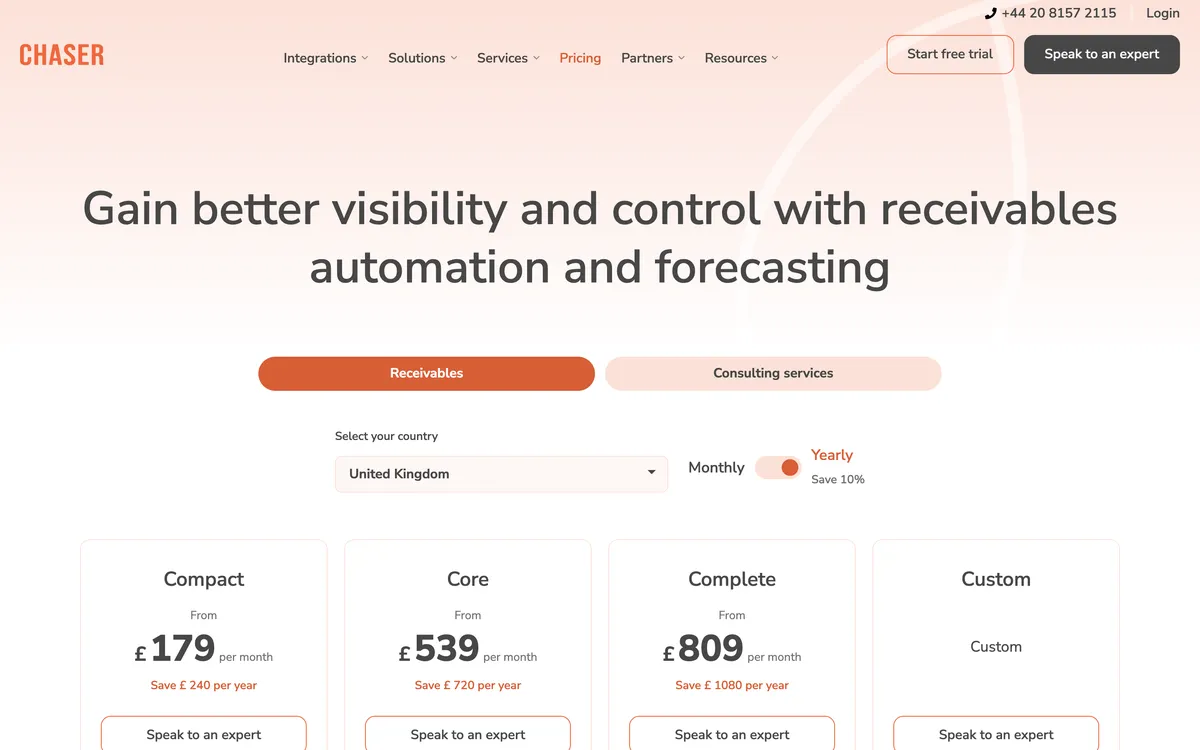
At £500k. Chaser is £199 a month on Compact, the same £199 it charges a business eight times larger, because Compact covers everything to £4m.
Paidnice at that size is usually Essentials at £49 for 150 invoices a month, or US$69 on the US price table. Chaser costs roughly four times as much here, and the difference buys credit checking, posted letters and automated calls.
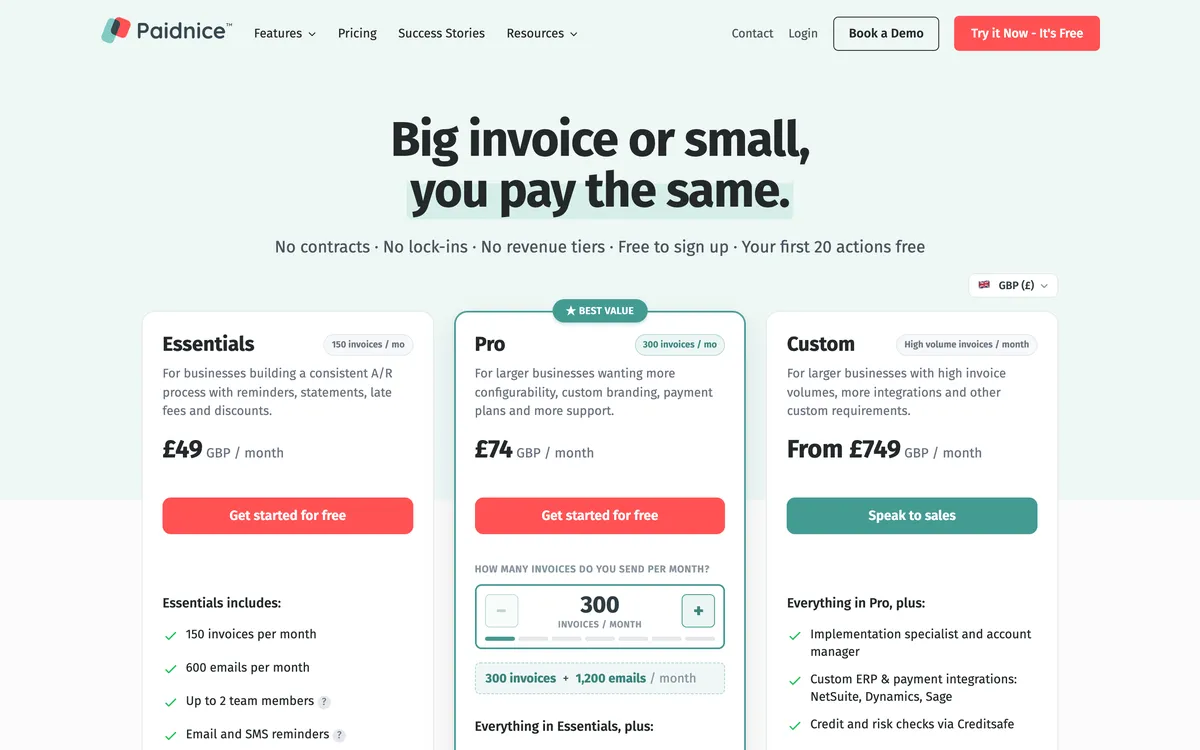
At £4m. Chaser is still £199, which is the same price at any turnover in its band and the point at which a turnover meter works in the buyer’s favour. Paidnice has moved with the invoice count by then, to Pro from £74 at 300 invoices or £129 at 600.
This is the crossing point, and invoice size decides which side you land on: a £4m consultancy raising 200 large invoices a month pays Chaser more, and a £4m distributor raising 2,000 small ones pays Paidnice more.
At £10m. Chaser steps to Core at £599, which adds unlimited users, templates and schedules, 600 credits, multi-entity and call recording, and then to Complete at £899 covering to £100m.
Paidnice steps only when the invoices do, reaching £599 at 4,000 a month, with Custom from £749 quoted for an ERP connection at any volume. A £10m business raising 200 invoices a month pays Chaser £599 and Paidnice £74 for the same twelve months of work.
Two extras belong in the same budget line. Chaser’s AR forecast is £9 a month on top and the Cash flow plan is a separate £29 a month subscription, extra templates or schedules £5, and every chasing channel and credit check is metered.
Paidnice meters SMS at £0.05 and charges £19 a month for each further Xero or QuickBooks Online organisation, and bills from a fixed local price table rather than an FX conversion.
Neither vendor pays to be here. Both prices come from the vendors’ own pricing pages. Check current pricing with the vendor before you budget on it.
Paidnice
Paidnice is a reminder, late fee and interest tool for Xero or QuickBooks Online ledgers that hold more than one kind of customer, up to 50,000 invoices a year, from £49 a month.
Who should choose Paidnice?
Choose Paidnice if you already know which accounts you are willing to charge and which you are not, and want both answers running at once instead of picking one for the whole ledger.
- Fits
- Businesses on Xero and QuickBooks Online of any size up to $50m a year, or 50,000 invoices a year, with or without a credit controller
- Regions
- United States, United Kingdom, Australia, New Zealand, Canada, South Africa
- Entry cost
- £49/mo on Essentials, covering 150 invoices, 600 emails and up to 2 team members; US$69 and A$99 in local price tables, not converted; Pro from £74/mo with unlimited users and no per-seat fee; Custom from £749/mo.
- Rated
- 5.0 from 83 Xero App Store reviews; 4.9 from 14 on Capterra · Xero App Store listing
- Awards
- Winner, New Zealand Small Business App of the Year, Xero Global App Awards 2026; 2025 Xero Global Small Business App of the Year
- Runs on
- Xero, QuickBooks Online, Stripe, Pinch Payments, CloudDepot, HubSpot, Pipedrive, Zapier. NetSuite, Sage Intacct, MYOB and Dynamics 365 Business Central on the Custom plan only
- Late fees and interest
- Yes. Flat, percentage and compounding charges, with a Bank of England base rate toggle for UK invoices, raised on the ledger as Draft or Approved. Policies sit under customer groups, so several run at once
- Does best
- Two charge types on the same customer group, an invoice late fee and a statement interest charge, both posted to the ledger
Where Chaser holds one fee rule for the account, Paidnice holds a policy per customer group, so a wholesale group, a retail group and a disputed-accounts group each run their own rate at the same time.
Two charge types are available on any one group: an invoice late fee per overdue invoice, and a statement interest charge on the whole overdue balance.
Around that runs the ordinary ladder, email and SMS from your own authenticated domain, statements on any schedule including consolidated parent and child accounts, prompt payment discounts, payment plans, a customer payment portal and escalation through manual task workflows.
The charge is raised on the ledger as a posted invoice, Draft or Approved, which is the mechanism that matters: only a posted document enters the customer’s own payables, their aged payables report and their next payment run.
Statement interest recalculates at the moment the statement sends rather than at the last policy run, so the figure the customer opens is accurate that morning, and it is netted against any credit on the account. Compounding is on by default; simple interest is the deliberate choice.
For UK invoices the rate can track the Bank of England base rate, applying the correct base rate for each period an invoice spans rather than the rate that happens to be current when the charge fires.
Paidnice uses AI to read inbound replies, log payment promises and draft the answer; a person approves each draft before it sends, unless you pre-approved that action type. Customers can query an invoice or promise to pay from the portal, and SMS and email replies land in Paidnice. On Pro and Custom plans its MCP server connects Claude, ChatGPT or any agent with a custom connector, and one connection covers every organisation. Further Xero or QuickBooks Online organisations are added at £19 per entity a month.
Limitations with Paidnice. Posted letters are on Pro and up, on request. Calls are made by a person from inside Paidnice, recorded and transcribed.
Its native connectors are Xero and QuickBooks Online. NetSuite, Sage Intacct, MYOB, Dynamics 365 Business Central and other cloud ERPs connect on the Custom plan; desktop ledgers such as Sage 50 and Sage 200 are not supported.
The entry tier covers two team members. Chaser has the larger verified review base, 4.98 from 374 against 5.0 from 83.
Best suited for: Xero or QuickBooks Online businesses that want a different late fee or interest policy for each customer group, priced by invoice volume. The drawback is that any ledger other than Xero or QuickBooks Online needs the Custom plan.
Chaser
Chaser is a credit control tool with a Creditsafe bureau file and every chasing channel behind one login, from £199 a month for turnover up to £4m.
Who should choose Chaser?
Choose Chaser if you would rather screen a customer before extending terms than argue with them afterwards, and want the screening, the email, the SMS, the posted letter and the call all metered on one bill.
- Fits
- Businesses with a named credit controller; the entry tier is priced for £4m turnover and under, and the tiers run to £100m
- Regions
- UK-registered, trading since 2014, sells worldwide. Automated calls are not available in New Zealand
- Entry cost
- £199/mo on Compact for turnover to £4m with 4 users; Core £599/mo to £10m; Complete £899/mo above that; Chaser Care from £899/mo, bundled with the software. A demo is required to buy.
- Rated
- 4.98 from 374 Xero App Store reviews; 4.5 from 68 on G2; 4.9 from 45 on Capterra · Xero App Store listing
- Awards
- Xero App Partner of the Year 2023
- Runs on
- Xero, QuickBooks, Sage 50, Sage 200, Sage Intacct, Sage Business Central, NetSuite, Dynamics 365, AccountsIQ, SAP, HubSpot, Gmail, Outlook, CSV
- Late fees and interest
- Yes. Four calculation types including a Bank of England base rate type, recalculated daily, but one global rule only, which cannot vary by schedule or customer group, and no fee is raised on payment-plan or partially paid invoices
- Does best
- Creditsafe credit checking and monitoring in the same tool as email, SMS, letter and automated-call chasing
Chaser has traded since 2014 and holds the larger verified review base of the two, 4.98 from 374 Xero App Store reviews.
Reminders leave from the team’s own Gmail or Outlook mailbox, so replies land where the controller already works, and SMS, posted letters, one-way automated calls, a payer portal and an integrated handover to a collections partner sit behind the same login.
Every channel is metered by credit, which means a difficult month costs more than a quiet one: SMS at £0.05 to £0.07, letters at £1.25 to £1.50 a credit, calls at £0.08 a credit-minute.
The credit report is the part that has no equivalent on the other side of this page. Creditsafe supplies a credit score with a recommended limit, the customer’s own payment score, credit event history, and Companies House filing and director data, with continuous monitoring on top.
Checks cost 1 credit for the UK and Ireland and 4 elsewhere, so careful screening is a line on the bill rather than a free habit.
Chaser Care runs the chasing as a managed service from £899 a month, sold as bundles at £899, £1,599 and £2,099 that carry the software and call hours together, and there is a white-label build for accounting firms.
A demo is required to buy, there is a 10-day trial, and annual billing takes 10% off.
Limitations with Chaser. The late fee is a single account-wide setting, so the rate that suits your trade customers is the rate your retail customers get.
No fee is raised on an invoice that is partly paid or sitting on a payment plan, and the line-item sync of the fee into the ledger works on Xero and not on QuickBooks. Statements go monthly only, on a fixed day, with recipients and senders not customisable.
Compact caps the team at four users, at £10 a month for each one beyond that. The tiers step on company turnover rather than invoice volume, so growth alone moves the bill. Reviewers report that a reply to a chasing email cannot be answered from inside the tool.
Best suited for: UK businesses with a named credit controller who want Creditsafe checks, posted letters and automated calls on one bill. The drawback is a single account-wide late fee rule and a price that steps with company turnover rather than invoice volume.
Which suits a small Xero business, Chaser or Paidnice?
Under £2m of turnover the two prices sit roughly four to one apart, and the choice turns on whether you need a credit bureau or a per-customer fee.
Chaser’s Compact tier is £199 a month whether you turn over £300k or £4m, because the meter is company turnover. A business at £1m raising 80 invoices a month pays the same as one at £4m raising 400.
Paidnice on the same ledger is £49 on Essentials for 150 invoices and two team members, or £74 on Pro 300 with unlimited users.
What the extra £150 a month buys is the Creditsafe file, posted letters and automated calls. A small business that extends terms to new trade accounts without screening them is the buyer for that.
A small business whose problem is good customers paying late has no use for the bureau and every use for a charge that lands in the customer’s payables.
Should you prevent the debt with credit checks or price it with a fee?
Chaser leads with a bureau credit check, a decision you make before the invoice exists, and Paidnice leads with a fee, a consequence that attaches after it goes unpaid. Only one of the two is a fee, and neither is a substitute for the other.
Screening reduces the number of accounts that can go bad. Chaser’s in-app Creditsafe report gives a score with a recommended limit, the customer’s payment score, credit event history and Companies House filing and director data, monitored continuously.
If the pattern you keep hitting is a customer who was never good for the money, that is the half of the problem worth buying.
A posted charge changes what lateness costs a customer who is already late. It arrives in their payables, ages on their own aged payables report, and can be waived deliberately, in writing, in exchange for payment today, which is a negotiating position a reminder does not give you.
If the pattern you keep hitting is a good customer who pays everyone else first, that is the half worth buying.
Neither product is an external recovery agency. Chaser hands an unpaid invoice to a collections partner from inside the tool, on success fees that step down with the size of the debt. Paidnice escalates through manual task workflows inside your own ledger and leaves the handover to you. Both stop before an account is written off.
How do the Paidnice and Chaser Xero reviews compare?
Chaser holds 4.98 from 374 Xero App Store reviews. Paidnice holds 5.0 from 83, all of them five-star. Chaser has the larger and older review base, Paidnice the perfect score.
On the Xero App Store Chaser has been listed since May 2015 and sits at 4.98 from 374 reviews. Paidnice has been listed since December 2021 and sits at 5.0 from 83, 100% five-star.
Both are listed under Debtor management. A review base four and a half times larger, listed six years longer, is the more reliable signal, and it is Chaser’s.
Off the Xero store, Chaser holds 4.5 from 68 on G2 and 4.9 from 45 on Capterra. Paidnice holds 4.9 from 14 on Capterra and 4.7 from 29 on Trustpilot.
The negatives are specific: a Chaser reviewer on Capterra wrote that replies to chasing emails cannot be answered inside the tool; a Paidnice reviewer on Capterra called setup “still a bit clunky and not intuitive enough”, and another asked for bulk removal of late fees.
Which product applies UK statutory interest to which invoice?
Chaser is a UK vendor and both products document a Bank of England base rate calculation, so the statutory question carries more weight on this pairing than on any other in the category.
Under the Late Payment of Commercial Debts (Interest) Act 1998 a UK business can charge 8% a year above the Bank of England base rate on an overdue B2B invoice, plus a fixed sum of £40, £70 or £100 by size of debt.
The entitlement exists whether or not your terms mention it, and the base rate moves, so check the current figure on GOV.UK before you invoice for it.
Chaser runs the base rate type as one global rule, recalculated daily and applied across the account.
Paidnice runs it as a policy under a customer group, applying the correct base rate for each period an invoice spans, so an invoice that stayed overdue across a rate change is charged at both rates rather than at whichever one happens to be current when the charge fires.
Statutory interest is the one case where a single account-wide rule is a reasonable fit, because the entitlement is the same for every B2B customer you have. It stops fitting the moment you want a commercial rate on some accounts and only the statutory minimum on others, which is the same grain problem the configuration section above walks through.
On $12,000 overdue for 30 days, a 2% invoice late fee is $240.00 and statement interest at 12% a year is $118.36, so $358.36 is added to the ledger.
The invoice late fee is a percentage of the overdue invoice. Statement interest is the balance multiplied by the annual rate, apportioned over the days it was late. Chaser applies one such rule across the account; Paidnice can run a different one per customer group, and both charge types on the same group.
How do Paidnice and Chaser compare in New Zealand?
Paidnice prints a New Zealand dollar price and won Xero’s NZ Small Business App of the Year 2026. Chaser publishes NZ$399 a month on Compact and does not offer automated calls in New Zealand.
Paidnice bills from a fixed New Zealand dollar price table, excluding GST. Chaser also publishes New Zealand dollar prices, from NZ$399 a month on Compact for revenue under NZ$8m, and Chaser’s automated calls are not available in New Zealand, which removes one of the channels the price pays for.
| Tier | Paidnice (NZ$ a month, excluding GST) | Chaser (£ a month) |
|---|---|---|
| Entry | NZ$109 Essentials, 150 invoices, 2 team members | £199 Compact, turnover to £4m, 4 users |
| Second tier | NZ$149 Pro 300, unlimited users | £599 Core, turnover to £10m, unlimited users |
| Third tier | NZ$289 Pro 600 | £899 Complete |
| Further Xero organisation | NZ$49 per organisation a month | Multi-entity from Core |
The enforcement context is different too. New Zealand invoices were paid in 24.1 days on average in the June 2026 quarter, 4.7 days late, on Xero’s Small Business Insights. Where a charge and a reminder ladder fail, the Disputes Tribunal hears claims to $60,000 from 24 January 2026, with a $468 filing fee on the top band.
The Limitation Act 2010 gives six years to bring the claim. Both products stop before that step: Chaser hands over to a collections partner, Paidnice leaves the handover to you.
Chaser’s UK statutory interest calculation has no New Zealand equivalent, so the rate you can charge is the one your terms state. Paidnice’s per-group flat, percentage or compounding policy fits that, and it posts the charge to the Xero organisation as a Draft or Approved invoice.
Which credit control software fits your use case?
Start from the job you need done first. The ledger you run and the channels you need settle most of these rows before price does.
| Use case | Start with | Why |
|---|---|---|
| Screening new trade accounts before you extend terms | Chaser | Creditsafe credit checking sits in the same tool; Paidnice runs native checks from payment behaviour, plus Creditsafe via API on the Custom plan. |
| Trade, retail and disputed accounts on one Xero or QuickBooks Online ledger | Paidnice | A separate fee and interest policy runs under each customer group. |
| Reminders and statements only, no late fees | Paidnice | Statements go on any schedule from £49 a month; Chaser sends them monthly on a fixed day. |
| Ledger on Sage 50 or Sage 200 | Chaser | Chaser connects to both; Paidnice does not serve either. |
| Posted letters and automated calls as standard channels | Chaser | Paidnice posts letters on Pro and up, on request, and records calls made by a person. |
| A New Zealand business that wants a local price | Paidnice | Paidnice starts at NZ$109 a month; Chaser starts at NZ$399 and has no automated calls in New Zealand. |
What do buyers ask when they have shortlisted these two?
The questions that come up once a UK credit team has narrowed it to this pair and has to write the difference down for whoever signs the budget.
Can Chaser charge one rate to trade customers and another to retail?
No, Chaser cannot charge one rate to trade customers and another to retail. Chaser’s late fee is a single global rule that cannot vary by schedule or customer group, so one rate applies to the whole account.
Paidnice attaches the policy to a customer group, so a wholesale group at 2% and a retail group at nothing run at the same time on the same ledger.
What happens to the fee when a customer pays half the invoice?
Chaser raises no fee on a partially paid invoice, so the remaining balance is out of reach until it is settled. Paidnice calculates statement interest on the overdue balance rather than the invoice face value, so the part payment reduces the charge rather than cancelling it, and interest is netted against any credit on the account.
Which one applies UK statutory interest correctly across a base rate change?
Paidnice and Chaser both document a Bank of England base rate calculation. Chaser recalculates its global rule daily. Paidnice applies the correct base rate for each period the invoice spans, so an invoice that stayed overdue through a rate change is charged at both rates.
At what size does Chaser stop being the more expensive option?
Chaser stops being the more expensive option at a size that depends on invoice count rather than turnover.
Chaser is £199 a month at any revenue to £4m, so at £4m with a high invoice volume it can be the cheaper of the two, while Paidnice has stepped to £129 at 600 invoices a month. Above £10m Chaser is £599 or £899 and Paidnice may still be on £74.
Do I keep credit checking if I choose Paidnice?
Yes. Paidnice runs native credit checks from each customer's payment behaviour, and Creditsafe bureau checks through the API on the Custom plan. On Essentials and Pro there is no bureau score or recommended limit. Posted letters are on Pro and up, on request. Calls are made by a person from inside Paidnice, recorded and transcribed.
Does either one sync the fee into Xero as a line item?
Chaser’s line-item sync of the fee is Xero only and does not work on QuickBooks. Paidnice raises the charge as a separate Draft or Approved invoice on either ledger, which is what puts it into the customer’s own payables rather than onto the original document.
Does either tool replace an external recovery agency?
Neither collects the debt itself. Chaser hands an unpaid invoice to a collections partner from inside the product, on success fees that step down with the size of the debt. Paidnice escalates through manual task workflows and leaves the handover to you.
Related comparisons for a UK credit team
Alternatives
Best Chaser alternatives
Six Chaser alternatives on enforcement, price and verified reviews.
Buyer's guide
Best accounts receivable software
The pillar guide, compared by business size and accounting system.
Credit control
Best credit control software UK
Six tools compared on statutory interest grain and published price.
Buyer's guide
Credit control software for Xero
Where it fits, what it costs, and how to choose for a Xero account.