Chaser vs Upflow: choose Chaser if an overdue invoice should end in a Bank of England base rate charge, at a printed £199 a month; choose Upflow if your finance team wants countback DSO first. Upflow hands any late fee to your ERP and is now quote-only, last reported at $440 (Grow) and $880 (Scale) in 2024.
The charge-or-measure split drives most rows in the table below. It also explains the prices: Chaser prints one that a buyer can pay by card, and Upflow quotes after a sales meeting.
UK small businesses wait 29.3 days to be paid and settle 8.3 days past due, on Xero Small Business Insights data for June 2026, and a manufacturer waits more than twice as long as a hospitality business. Every one of those figures is a measurement, and this comparison is about what a tool does after the measuring.
What does credit control software do?
Credit control software works the overdue invoices on a ledger. Both tools here read invoices from Xero, QuickBooks Online, NetSuite or Sage Intacct, run reminder workflows by email, SMS and letter, give customers a portal, and score credit risk: Chaser through Creditsafe, Upflow with light scoring.
They differ on what follows the reminder. Chaser raises a charge, a Bank of England base rate fee posted to Xero as an invoice line, and adds payment plans and monthly statements. Upflow measures, with countback DSO, collection effectiveness, an at-risk rate and cash forecasting.
What it is not:
- Not the ledger or the ERP. Xero, QuickBooks Online or NetSuite keeps the books. Upflow sends any late fee back to the ERP to raise.
- Not a debt collection agency. Chaser offers a partner collections route once chasing has run out; the tool itself reminds and charges.
- Not a credit bureau. Chaser’s in-app report is supplied by Creditsafe, and Upflow scores customers without bureau data.
- Not the source of the entitlement. The Late Payment Act already gives a UK supplier interest and a fixed sum; the software decides only which system raises it.
It sits between the ledger and the customer. Invoices come in from the accounting system, and reminders, charges and reports go back out.
How do Chaser and Upflow compare?
Chaser and Upflow differ most on two rows: what each tool does about a late fee, and what each one prints as a price. Everything after them is a consequence.
 |
 |
|
|---|---|---|
| Best for | UK credit controllers who want overdue invoices to end in a charge | Analytics-led finance teams that measure collections before automating |
| Revenue fit | £4m and under on the entry tier, tiers to £100m | Gross invoice value tiers, up to $10m through above $100m |
| From (monthly) | £199 | Not published |
| Billing model | Revenue-tiered, published, with channel credits metered on top | Quoted by gross invoice value tier, nothing printed |
| Ledger integrations | Xero, QuickBooks, Sage 50, Sage 200, Sage Intacct, Sage Business Central, NetSuite, Dynamics 365, AccountsIQ, SAP | Xero, QuickBooks Online, NetSuite, Sage Intacct, Stripe Billing, Chargebee, Zuora |
| Late fee grain | Yes (one set of rules for the account); four calculation types including the Bank of England base rate | No (via your ERP only) |
| Reminder channels | Email, SMS, letter and automated call, all credit-metered | Email, SMS and letter automatically, calls and tasks as manual steps |
| Statements | Yes (monthly, fixed day) | Portal PDF statement, no scheduled send |
| Payment plans | Yes (per invoice, weekly to yearly) | No (customer-initiated part payments and promises to pay) |
| Portal | Yes | Yes |
| Credit checks | Yes (Creditsafe) | Yes (light scoring) |
| Collections analytics | Yes (customer insights and DSO, with the receivables forecast as a paid add-on) | Yes (countback DSO against best possible DSO, collection effectiveness, at-risk rate, aging) |
| Rated | 4.98 from 374 on the Xero App Store, 4.5 from 68 on G2, 4.9 from 45 on Capterra | 4.8 from 233 on G2, 4.5 from 15 on Capterra, 5.0 from 1 on the Xero App Store |
Three cells carry a fixed meaning. “Not published” is used where the vendor prints no figure of any kind. “Not documented” is used where the vendor does not document the capability. “None found” is used where nothing in those materials points either way. A third-party figure rather than a published one is labelled where it appears.
Chaser
Chaser is a UK credit control tool that raises a statutory interest charge and runs Creditsafe credit checks, from £199 a month for turnover up to £4m.
Who should choose Chaser?
Choose Chaser if you are a UK credit controller who wants the overdue invoice to end in a charge rather than in a report, on Xero, QuickBooks, Sage or NetSuite.
- Fits
- UK-centred businesses with a named credit controller; the entry tier is priced for £4m turnover and under, and the tiers run to £100m
- Regions
- UK-registered, trading since 2014, sells worldwide
- Entry cost
- £199/mo on Compact for turnover to £4m with 4 users, 30 templates, 4 schedules and 100 SMS and 100 call credits; Core £599/mo to £10m; Complete £899/mo above that; Chaser Care, the managed service sold bundled with the software, from £899/mo on Compact (£1,599 on Core, £2,099 on Complete). Check current pricing with the vendor.
- Rated
- 4.98 from 374 Xero App Store reviews; 4.5 from 68 on G2; 4.9 from 45 on Capterra, mostly 2020 to 2022
- Awards
- Xero App Partner of the Year 2023
- Runs on
- Xero, QuickBooks, Sage 50, Sage 200, Sage Intacct, Sage Business Central, NetSuite, Dynamics 365, AccountsIQ, SAP, HubSpot, Gmail, Outlook
- Statutory late fees
- Yes. Four calculation types including a Bank of England base rate type, recalculated daily, but one set of rules for the account, applied to every debtor or to selected debtors, and no fee is raised on payment-plan or partially paid invoices
- Does best
- Creditsafe credit checking and monitoring in the same tool as email, SMS and letter chasing
Everything Chaser does points at an action taken against an overdue invoice. Reminders leave the controller’s own Gmail or Outlook mailbox on schedules that run before the due date, after it and on payment, with only the final overdue step repeating.
SMS, letters, one-way automated calls and manual in-app calls with recording escalate from there, and every channel beyond email is metered in credits, so the bill moves with how hard the account is chased.
The charge is the end of that ladder rather than an add-on to it. Four calculation types are available, one of them follows the Bank of England base rate and recalculates daily, and the fee posts to Xero as an invoice line, which means it appears on the customer’s statement rather than in your reporting.
Around that sit the parts a controller touches daily: a per-customer portal for viewing, paying and raising disputes, per-invoice payment plans from weekly to yearly, monthly statements on a fixed day, Creditsafe checks at one credit in the UK and Ireland and four elsewhere, and a partner collections route once chasing has run out.
Payments run through Chaser Pay on Stripe rails, which is mutually exclusive with connecting your own Stripe account.
Limitations with Chaser. The late fee is one set of rules for the account. Its rate cannot vary by customer group, it raises no fee on payment-plan or partially paid invoices, and the line-item sync back to the ledger is Xero only.
Statements are monthly on a fixed day with no control over senders or recipients. Payment plan chasing follows the original invoice due date rather than the instalment dates, and Chaser’s own documentation advises chasing instalments manually.
The entry tier covers four users, the price steps with company turnover rather than with usage, and the published revenue caps disagree between the pricing page and the plan detail. Reviewers ask for deeper report customisation and note that replies to a chase cannot be answered directly.
Best suited for: A UK credit controller who wants an overdue invoice to end in a statutory interest charge, with Creditsafe checks, from £199 a month. The drawback is one set of late fee rules, monthly statements on a fixed day and a price that steps with turnover.
Chaser vs Upflow: Charge or Measurement, Which Fits Your Team (1:42)
Video chapters and transcript
- 0:00 Short answer
- 0:26 Chaser and Upflow side by side
- 1:06 Choose it if
Chaser versus Upflow: which one fits? Chaser acts on an overdue invoice, and Upflow reports on one. Chaser raises a Bank of England base rate charge itself and prints a price of 199 pounds a month.
Upflow measures countback DSO against best possible DSO, hands any late fee back to your ERP, and publishes no price at any tier. On the late fee, Chaser raises the charge itself, with four calculation types, while Upflow leaves it to your ERP. On price, Chaser starts at 199 pounds a month, and Upflow is quote only.
Grow and Scale were last verified by a third party at 440 and 880 dollars a month. On payment plans, Chaser splits an invoice weekly to yearly. Upflow offers part payments and promises to pay.
On credit checks, Chaser uses Creditsafe and Upflow uses light scoring. On analytics, Upflow is the sharper of the two. Choose Chaser if you are a UK credit controller who wants an overdue invoice to end in a charge, at up to 4 million pounds turnover on the entry tier.
Choose Upflow if your finance team manages by metric and wants to see what the current process costs before it automates a reminder. If nobody can say what your DSO is, start by measuring. If everyone can, and it has not moved, a charge is the next step.
Upflow
Upflow is a collections analytics platform for analytics-led finance teams, quoted in five tiers by gross invoice value, from up to $10m to above $100m, last reported at $440 (Grow) and $880 (Scale) a month in 2024 and now quote-only, so request a quote.
Who should choose Upflow?
Choose Upflow if your finance team will not automate a reminder until it can show what the current process costs, on Xero, QuickBooks Online, NetSuite or Sage Intacct.
- Fits
- B2B finance teams that manage by metric, quoted in five tiers by gross invoice value, from up to $10m on Starter to above $100m on Enterprise
- Regions
- New York head office, Paris origin, customers in 30-plus countries
- Entry cost
- Not published. Upflow prints no figures and quotes five tiers by gross invoice value; its pricing FAQ mentions a free Discover plan for analytics, but it is not among the plan cards. Third-party listings showed Grow at $440 a month and Scale at $880.
- Rated
- 4.8 from 233 G2 reviews, latest June 2026; 4.5 from 15 on Capterra · Xero App Store listing
- Awards
- Not published
- Runs on
- Xero, QuickBooks Online, NetSuite, Sage Intacct, Stripe Billing, Chargebee, Zuora
- Statutory late fees
- No, via your ERP only. Upflow's own documentation points the job back to the ERP and there is no native computation
- Does best
- Collections analytics, with countback DSO against best possible DSO, collection effectiveness and an at-risk rate above 90 days
Upflow’s argument is that a collections process nobody has measured cannot be improved on purpose, and its metrics are the core of the product: countback DSO set against best possible DSO, collection effectiveness, at-risk balances above 90 days, aging and billing-cohort cash forecasting, on dashboards filtered by workflow, country or account manager and scheduled out by email.
Discover, the free tier, shows the numbers and sends no reminders.
Chasing sits on top of the measurement rather than beside it. Multi-step workflows mix email, SMS, letter, call and task actions, with only the first three sending by themselves, and timing is set against invoice age, customer behaviour and risk profile rather than one cadence for everybody.
Cash application matches incoming payments with suggestions and rules, and an agent reconciles from an uploaded bank CSV.
Its AI releases have come at a steady cadence: promise-to-pay detection in December 2025, dispute-signal detection in February 2026, and custom-field autofill in July 2026. All of these features read the ledger, and Upflow raises no charge from any of them.
Limitations with Upflow. No native late fees, so any charge goes back to your ERP, and no interest calculation of any kind. No instalment plans at all: a customer can make a part payment or record a promise to pay, and nothing else is scheduled.
Statements are a PDF the customer downloads from the portal; there is no scheduled statement send. Automatic actions fire once a day at a fixed time, on business days only.
Sending through your own SMTP disables open and click tracking, and the QuickBooks link is one-way, polls every five minutes rather than using webhooks, caps custom fields at three, and lands payments in Undeposited Funds for manual reconciliation. Its last reported prices were $440 a month for Grow and $880 for Scale in 2024, now hidden, request a quote.
Best suited for: An analytics-led finance team on Xero, QuickBooks Online, NetSuite or Sage Intacct that wants countback DSO before it automates. The drawback is that no price is published, with no native late fees and no instalment plans.
What is the difference between a charge and a measurement?
Chaser raises a charge on an overdue invoice and Upflow measures it: put one £6,000 invoice on 30-day terms through both products and the difference shows at about day 30.
One overdue invoice, followed through both products.
Neither behaviour is wrong. A team that buys the wrong one has usually bought for the wrong stage of its process. If nobody in the business can say what the current DSO is, a charge is being bolted onto a process that has never been looked at.
If everybody can say what it is and it has not moved in four quarters, another dashboard will not move it either.
One set of rules for the account (Chaser)
- Four calculation types, the base rate among them
- Recalculated daily
- The same rate applied to every customer
- Nothing charged on a plan or a part-paid invoice
- Line-item sync back to Xero only
Back to the ERP (Upflow)
- No native computation at all
- The charge is raised in NetSuite, not in Upflow
- Nothing tracks the base rate
- No fixed compensation handling
- Reporting only, after the fact
The same row read twice. Chaser computes the charge, posts it and lets you trade it away. Upflow watches a charge that somebody else raised in the ERP.
What does countback DSO tell you that a fee cannot?
Countback DSO tells you how long the money actually took to arrive, which a fee cannot, and it is the metric Upflow is built around.
A standard DSO divides the receivable balance by revenue and multiplies by days, which smears one slow month across a fast one and flatters a business with rising sales.
A countback works backwards through the ledger, taking the outstanding balance out of the most recent period first, so what comes out is how long the money actually took rather than an average of the whole book.
Upflow reports that against a best possible DSO, which is the figure you would see if every customer paid exactly on terms. The gap between the two is the part of the delay that is yours to act on, and it is the only number on this page that tells you whether chasing harder is worth doing at all.
Around it sit collection effectiveness, an at-risk rate above 90 days, aging and billing-cohort forecasting. Chaser reports customer insights and DSO, and charges £9 a month for the receivables forecast and £29 a month for the separate Cash flow plan, so the measurement side is present but priced as an extra rather than built as the product.
None of it changes the amount the customer owes.
How do you buy from a vendor that publishes no price?
Chaser prints its price and Upflow does not, which makes the printed price a buying criterion in itself.
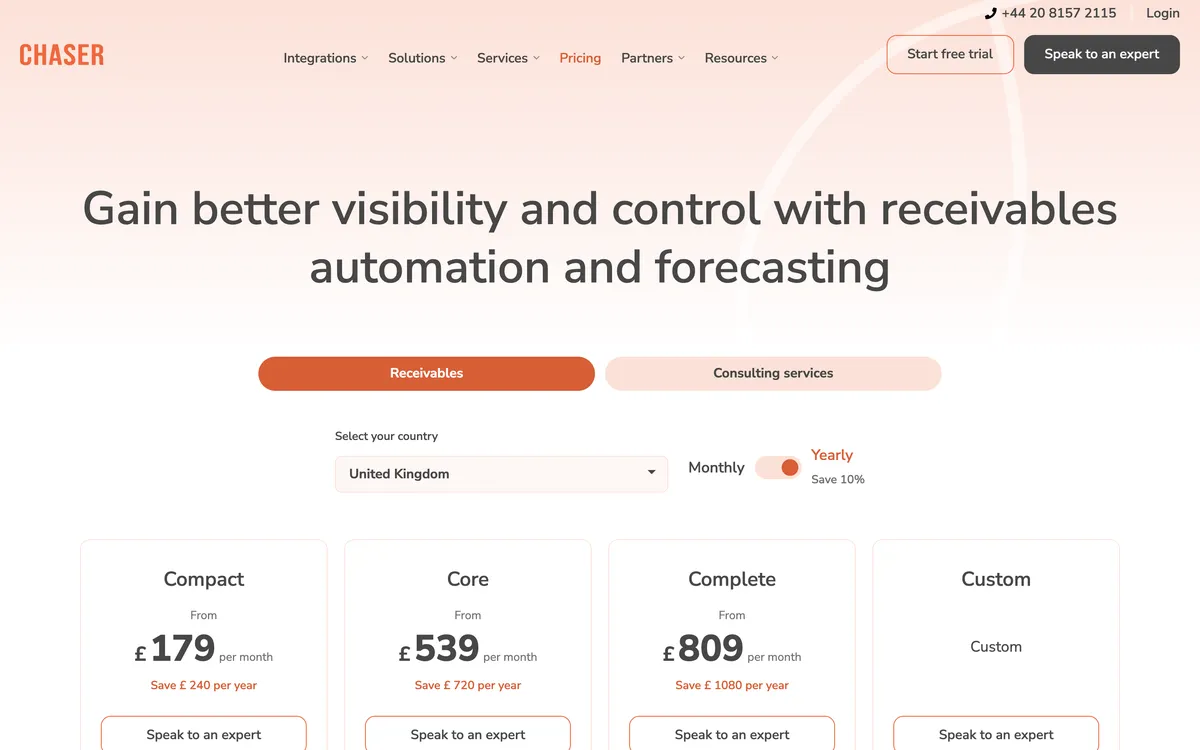
Chaser prints £199 a month on Compact for turnover to £4m, £599 on Core to £10m and £899 on Complete above that, with Chaser Care from £899 a month bundled with Compact and channel credits metered on top. A finance manager can put those figures into a budget line before speaking to anybody.
Upflow prints nothing on any tier and quotes five tiers by gross invoice value. The $440 figure for Grow and $880 for Scale are third-party figures, not published by the vendor, so they are a starting point for a conversation rather than a price.
Its pricing FAQ mentions a free Discover plan, but it is not among the plan cards.
The cost of that to a buyer is comparability. A quote arrives shaped by what the salesperson learned about your ARR on the discovery call, so the number you are given is not the number another company in the same band is given, and there is nothing printed to hold the vendor to at renewal.
It also removes the cheap first step. Software with a printed price can be signed off by one person, tried for a month and cancelled. Software without one needs a meeting, a demo and an internal case before anyone has seen it run against a real ledger.
If you shortlist Upflow anyway, ask for three things in writing: the band you sit in, the rate at the top and the bottom of that band, and what happens to the price on the day your ARR crosses into the next one.
Who holds the Late Payment Act entitlement when the software only reports?
A UK supplier already holds the Late Payment Act entitlement, and the question is which system holds it for them: Chaser raises the charge, Upflow sends it to the ERP.
Under the Late Payment of Commercial Debts (Interest) Act 1998 a UK business can charge interest on an overdue B2B invoice at 8% a year above the Bank of England base rate, plus a fixed sum of £40, £70 or £100 by size of debt.
With the base rate at 3.75% that is 11.75% in total, and it moves, so read the current figure off GOV.UK before you invoice for it.
The rate moving is what makes this software work instead of spreadsheet work. An invoice left long enough spans two or three base rates, and the charge has to be prorated across each period at the rate that applied.
Chaser recalculates daily and posts the answer. Upflow’s own documentation sends the job to NetSuite, so on a Xero or QuickBooks Online ledger the calculation, the posting and the audit trail all sit outside the tool that is running the chase.
- Statutory interest
- Base rate plus 8%, which comes to 11.75% at a 3.75% base rate. The figure tracks the base rate, so read it again on the day you raise the charge. GOV.UK
- Fixed compensation
- A per-invoice sum of £40, £70 or £100, set by how large the debt is and claimable in addition to the interest. GOV.UK
- Mandatory interest
- Proposed rather than enacted. The Commercial Payments Bill would turn statutory interest into a requirement in commercial contracts instead of a default two parties can contract out of. Check where the Bill has reached before you plan around it.
A controller can use the entitlement as a negotiating lever, and only Chaser puts it in their hand. A charge sitting on the customer’s ledger can be waived deliberately, in writing, in exchange for payment today. An account where the charge was never raised has nothing to trade.
A £5,000 invoice left 45 days past due at 11.75% carries £72.43 of statutory interest, and the fixed sum on a debt that size is £70, giving £142.43 claimable.
The interest is the invoice value at the annual rate, apportioned across the days the money was late. The fixed sum steps at £40 below £1,000, £70 from there to £9,999.99, and £100 at £10,000 and above. The rate follows the Bank of England base rate, so check GOV.UK before you invoice for it.
Which credit control software fits your use case?
Pick the row that matches the job in front of you. Each names the tool on this page that does that job and the reason from the sections above.
| Use case | Start with | Why |
|---|---|---|
| Statutory interest raised on overdue invoices | Chaser | Four calculation types, a base rate type recalculated daily, and the fee posted to Xero |
| Nobody can say what the current DSO is | Upflow | Countback DSO against best possible DSO shows how much of the delay is yours to act on |
| A budget line before speaking to sales | Chaser | £199, £599 or £899 a month by turnover; Upflow prints no price |
| A subscription business billing through Stripe Billing, Chargebee or Zuora | Upflow | It connects to those billing systems; Chaser does not list them |
| Customers who need payment plans | Chaser | Per-invoice plans from weekly to yearly; Upflow offers part payments and promises to pay only |
| Cash forecasting and collection effectiveness in the product | Upflow | Built in; Chaser charges £9 a month for the receivables forecast and £29 a month for the separate Cash flow plan |
What do buyers ask about Chaser and Upflow?
What buyers ask once both products are on the same shortlist: what the quote-only price means in practice, which tool charges interest, and which one reports countback DSO. If Satago is also on the shortlist, see Chaser vs Satago.
Should you choose Chaser or Upflow?
Chaser and Upflow fit different needs. Choose Chaser if you want a UK credit control tool that applies a Bank of England base rate charge, runs Creditsafe credit checks and monitoring, and publishes its price from £199 a month.
Choose Upflow if you want collections measurement: countback DSO against best possible DSO, collection effectiveness, at-risk balances and cash forecasting, and can work with a quote-only price.
How much do Chaser and Upflow cost?
Chaser is £199 a month on Compact for turnover up to £4m, £599 on Core to £10m and £899 on Complete above that, with Chaser Care bundled with Compact from £899 a month, credits on top. Upflow publishes no price and quotes five tiers by gross invoice value. Third-party listings showed Grow at $440 a month and Scale at $880.
Why does Upflow not publish a price?
Upflow removed its figures from its site and now quotes five tiers by gross invoice value. Its pricing FAQ mentions a free Discover plan, but it is not among the plan cards.
The practical effect is that no two buyers in the same band can compare what they were quoted, and there is no printed rate to hold the vendor to at renewal.
Do Chaser and Upflow apply UK statutory interest?
Chaser applies UK statutory interest. It offers four calculation types including a Bank of England base rate type, recalculated daily, as one set of rules for the account, applied to every debtor or to selected debtors, and it raises no fee on payment-plan or partially paid invoices.
Upflow does not: its documentation points the job back to your ERP and there is no native computation.
Which of Chaser and Upflow includes bureau credit checking?
Chaser includes bureau credit checking. Its in-app credit report is supplied by Creditsafe and carries a credit score with a recommended limit, the customer’s payment score, credit event history, and Companies House filing and director data, plus continuous monitoring and a late payment predictor. Upflow offers light customer scoring and risk-profile segmentation rather than bureau data.
Which of Chaser and Upflow reports countback DSO?
Upflow reports countback DSO against best possible DSO, collection effectiveness, an at-risk rate above 90 days, aging and billing-cohort cash forecasting, on dashboards filtered by workflow, country or account manager. Chaser reports customer insights and DSO, and charges £9 a month for the receivables forecast and £29 a month for the separate Cash flow plan.
Do Chaser and Upflow work with Xero and QuickBooks?
Chaser and Upflow both work with Xero and QuickBooks. Chaser adds the whole Sage range, NetSuite, Dynamics 365, AccountsIQ and SAP. Upflow adds NetSuite, Sage Intacct, Stripe Billing, Chargebee and Zuora, which is the row that decides it for a subscription business billing outside a general ledger.
Does either tool offer payment plans?
Chaser does, splitting an invoice from weekly through to yearly, though its chasing follows the original invoice due date rather than the instalment dates. Upflow does not: it offers customer-initiated part payments and promises to pay instead.
How were Chaser and Upflow compared?
The comparison rests on five questions, asked in this sequence.
- Does the tool act on an overdue invoice, or describe it? Chaser raises the charge. Upflow reports on a charge raised somewhere else.
- What does the vendor actually print? £199 a month against no figure at any tier.
- How much verified review evidence stands behind it, and how recent is it? 4.98 from 374 on the Xero App Store against 4.8 from 233 on G2, with Chaser’s Capterra base mostly 2020 to 2022.
- What does it reach beyond the ledger you already run? Chaser takes the accounting systems, including the whole Sage range. Upflow takes Stripe Billing, Chargebee and Zuora.
- Can the business be served at its current size, at a price it can sign off? Answerable for Chaser and not for Upflow, which is a finding about how much Upflow discloses.
Where a capability exists in one product and has no counterpart in the other, it is stated inside that product’s entry rather than used to favour either tool. Prices are from each vendor’s own site, in the currency the vendor prints, with no conversion applied, and third-party figures are labelled wherever they appear. Neither vendor paid to be here.
People also read
Alternatives
Best Chaser alternatives
Six Chaser alternatives on enforcement, price and reviews.
Alternatives
Best Upflow alternatives
Four Upflow alternatives compared by business type.
Buyer's guide
Best credit control software UK
Six tools compared on statutory interest grain and published price.
UK law
Late payment fees in the UK
The complete guide to the law, the rate and what is changing.
Sources
11 sources, checked by Julie Turnbridge on October 26, 2026
- Bank of England base rate bankofengland.co.uk/monetary-policy/the-interest-rate-ban...
- Xero Small Business Insights xero.com/uk/resources/small-business-insights
- Xero App Store apps.xero.com/uk/app/chaser
- G2 g2.com/products/chaser/reviews
- Capterra capterra.co.uk/software/157101/CHASER
- G2 g2.com/products/upflow-upflow/reviews
- Capterra capterra.co.uk/software/193097/Upflow
- Xero App Store listing apps.xero.com/us/app/upflow
- Late Payment of Commercial Debts (Interest) Act 1998 legislation.gov.uk/ukpga/1998/20/contents
- GOV.UK gov.uk/late-commercial-payments-interest-debt-recovery/ch...
- GOV.UK gov.uk/late-commercial-payments-interest-debt-recovery/cl...