Xero's own reminder schedule stops at five reminders and raises no charge. The five best invoice chasing software tools for Xero in 2026 are Paidnice, Chaser, Kolleno, Upflow and Satago, compared on native Xero fit and on whether the tool raises the late fee itself once the reminders run out. Prices from £45 a month.
| Tool | Best for |
|---|---|
| Paidnice | A Xero organisation that wants statutory interest applied per customer group, any size up to $50m a year, or 50,000 invoices a year |
| Chaser | Xero teams that want SMS, letters and bureau credit checks in the same tool, under £4m on the entry tier |
| Kolleno | Order-to-cash teams chasing across email, SMS and calls |
What invoice chasing software for Xero is (and what it is not)
Invoice chasing software for Xero is an App Store app that reads each invoice's due date and payment status, then runs the reminder ladder past Xero's fifth message: email and SMS reminders per customer group, statements, payment plans, a customer payment portal and, on some tools, a late fee or statutory interest charge.
It sits on top of the ledger. Xero keeps the invoices and the aged receivables report, and the app either writes something back, such as a charge raised as Draft or Approved, or keeps its activity on its own side.
What it is not:
- Not a replacement for Xero's own reminders, which are free and enough for a ledger of dependable customers.
- Not a debt collection agency. Chaser hands a debt to a collections partner network, but the app chases your own customers on your own terms.
- Not invoice finance, although Satago sells finance from the same provider.
- Not a credit bureau. Chaser carries Creditsafe reports and Satago credit scores. Paidnice runs native credit checks from each customer's payment behaviour, and Creditsafe bureau checks through the API on the Custom plan.
- Not a reconciliation tool by default. Kolleno matches payments to invoices (auto-reconciliation) on Enterprise only, by quote, but most of these apps only read payment status.
The late fee is optional. On this page Paidnice and Chaser raise one, and Satago adds an optional late fee to its reminder emails.
How this list was put together
This list helps a Xero business choose an app that keeps chasing after Xero's fifth reminder and raises the late fee itself.
| What we checked | Where the evidence came from |
|---|---|
| Native Xero connection that reads payment status, so chasing stops the day an invoice is settled | The Xero App Store listing and the vendor's Xero integration page |
| Channels past email, sent from an address the customer recognises | Vendor feature pages |
| What ends the sequence, and whether a charge is raised in Xero as a Draft first | Vendor help pages; where documentation is silent, the entries say so |
| Xero App Store rating with its review count | The Xero App Store, one review policy for all five; within a tenth of a point the larger base carries more weight, and G2 and Capterra scores order nothing |
| Published price on the Xero connection | Vendor pricing pages; two vendors publish cheaper tiers a Xero business cannot buy |
Where do Xero's own invoice reminders stop?
Xero will chase an invoice five times. After the fifth reminder the schedule has nothing left to send, and the debt carries on regardless.
The reminder count is capped at five per invoice.
The schedule is held once at organisation level, so a slow-paying wholesale account and a dependable retainer client receive the same messages on the same days in the same tone. And nothing in the sequence raises a charge, so an invoice that ignores all five reminders costs the customer exactly what it cost on day one.
Xero's reminders are free, they are already switched on in your account or two clicks from it, and for a ledger of dependable customers they are enough.
Why Xero raises no interest, and how long that has been true
The gap is well known and it is old. The request "Sales Invoices - Add interest to late invoices (including paid/part-paid Invoices)" was posted to the Xero ideas board on 29 March 2012. It carries 1,118 votes, and Xero's most recent response, dated 7 July 2025, states there are no committed plans.
Treat interest and late fees as something you buy separately rather than something to wait for, and read that decision alongside the UK credit control comparison, which works through what the statutory charge is worth and which tools compute it.
Which of these five apps sit in the Xero App Store debtor tracking category?
All five hold a live Xero App Store listing. Chaser leads on volume with 374 reviews at 4.98; Paidnice and Kolleno sit at 5.0 from 84 and 18; Satago 4.93 from 92; Upflow 5.0 from a single review.
The category label Xero prints on each listing was recorded where the store showed it. Paidnice and Chaser are both filed under Debtor management, the store's home for debtor tracking apps; Chaser also sits in Reporting and forecasting, and Paidnice in Invoicing and jobs.
| App | Xero App Store listing | Rating (reviews) | Category shown | Listed since |
|---|---|---|---|---|
| Paidnice | Yes, UK store | 5.0 (84, 100% five-star) | Debtor management; Invoicing and jobs | Dec 2021 (NZ store) |
| Chaser | Yes, UK store | 4.98 (374) | Debtor management; Reporting and forecasting | May 2015 |
| Kolleno | Yes, UK store | 5.0 (18) | Not recorded | Apr 2022 |
| Upflow | Yes, UK store | 5.0 (1) | Not recorded | Not recorded |
| Satago | Yes, UK store | 4.93 (92, 96% five-star) | Not recorded | Feb 2014 |
Ratings and counts are read from the live listings. "Not recorded" means the label or date was not captured in the check, not that the listing lacks one.
How do invoice reminder apps integrate with Xero?
Every app on this page connects to Xero through the App Store, reads invoices and payment status, and stops chasing the day a payment lands. The integration that matters is the return trip: which apps write a charge back.
How do the five Xero invoice chasing tools compare?
 |
 |
 |
 |
 |
|
|---|---|---|---|---|---|
| Best for | Statutory interest per customer group on Xero, any size to $50m | SMS, letters and credit checks in one tool, under £4m on entry | Order-to-cash teams chasing across email, SMS and calls | Analytics-led teams measuring collections before automating | UK Xero businesses wanting credit reports with their chasing |
| Revenue fit | Any size up to $50m a year, or 50,000 invoices a year | Compact under £4m, Core from £4m, Complete to £100m | Under £1m on BusinessPay, tiers to £1bn and above | Gross invoice value tiers, up to $10m through above $100m | Not published |
| From (monthly) | £49 | £199 | $650 per user | Not published | £45 standalone |
| Chasing channels | Email and SMS (own domain on Pro); in-app calls made by a person, recorded and transcribed | Email from your own mailbox, SMS, posted letters, automated calls | Email, SMS and calls; its pricing page does not say which actions a workflow can hold | Email, SMS, letter, call and task actions | Email; SMS from the £80 tier |
| Sends without a person | Yes, and the ladder differs by customer group | Yes, with channels metered by credit | Yes, with automatic escalation built into the branch | Partly. Automatic actions fire once a day, business days only | Yes, capped at 100 email reminders a month on Basic |
| What ends the sequence | A late fee or statement interest charge raised on the Xero ledger, then manual task workflows | One set of late-fee rules, then handover to an integrated collections partner | Escalation inside the workflow. No late fee or interest is documented | A task for a human. Fees are pointed back to the ledger | Nothing documented. The commercial exit is invoice finance |
| Late fee grain | Yes (per customer group) | Yes (one set of rules for the account) | None found | No (via your ledger only) | Optional fee added to reminder emails |
| Statements | Yes (any schedule) | Yes (monthly, fixed day) | Yes (in the portal) | Portal PDF statement, no scheduled send | Yes |
| Payment plans | Yes (Pro) | Yes (chased on the invoice due date) | Yes | No | Not documented |
| Portal | Yes | Yes | Yes | Yes | Not documented |
| Aged receivables view | By contact, in 1 to 30, 31 to 60, 61 to 90 and 90-plus day buckets | Xero's report, read from the organisation | Xero's report, read from the organisation | Xero's report, plus countback DSO and an at-risk rate above 90 days | Xero's report, read from the organisation |
| AI | Advanced Reads customer replies, drafts answers and follow-up actions (like PO updates) for your approval; MCP server for Claude, ChatGPT and other agents | Advanced Insights, Copilot drafts and an autonomous Agent; AI agent support from Business Plus | Advanced Collections and cash application agents, from suggest-only to autonomous (Collections Agent from Scale, Cash Application Agent from Accelerate) | None No AI feature found | |
| Rated (source, count) | 5.0 (84, Xero App Store) | 4.98 (374, Xero App Store) | 5.0 (18, Xero App Store) | 4.8 (235, G2) | 4.93 (92, Xero App Store) |
"Not documented" means the vendor does not document the capability. "Not published" means the vendor does not print a price. "None found" means no evidence either way. Prices are the vendor's published from-price.
The five tools in five checked facts
- Four of the five print a monthly price: Satago from £45, Paidnice from £49 (US$69), Chaser from £199 and Kolleno from US$650. Upflow does not publish one.
- Each published price grows with something different: a flat tier (Satago), invoice volume (Paidnice), revenue band (Chaser) and users (Kolleno).
- Three of the five apply a late fee themselves: Paidnice (per customer group), Chaser (one set of rules) and Satago (optional, added to its reminder emails).
- All five connect to both Xero and QuickBooks Online.
- AI that handles collections work or customer replies: Paidnice, Upflow and Kolleno. No AI in receivables: Satago.
We checked each tool's own pricing, integration and help pages on October 26, 2026. "None found" in the data means the vendor's pages do not show the feature.
What is the best invoice chasing software for Xero in the UK?
For a UK Xero organisation the shortlist is Paidnice at £49 (US$69) a month, Chaser at £199 on Compact, for turnover under £4m, and Satago at £45 standalone. Only the first two compute the statutory charge.
The UK test is the Late Payment of Commercial Debts (Interest) Act 1998: 8% above the Bank of England base rate, plus a fixed sum of £40, £70 or £100 per invoice by debt size. Paidnice and Chaser both calculate it and write the charge into Xero; Paidnice on a rule per customer group, Chaser on one set of rules.
Satago holds the UK bureau credit data and invoice finance, and adds an optional late fee to its reminder emails without documenting a ledger charge. Pick by ledger. Under £4m turnover with mixed customer groups, Paidnice.
1. Paidnice, best for statutory interest per group
Best for: A Xero organisation that wants statutory interest applied per customer group, any size up to $50m a year, or 50,000 invoices a year.
What is Paidnice best for?
For a business on Xero that wants reminders, statements and statutory interest running per customer group, with the charge posted straight back to the ledger.
- Fits
- Businesses on Xero and QuickBooks Online of any size up to $50m a year, or 50,000 invoices a year, with or without a credit controller
- Regions
- United Kingdom, Australia, New Zealand, United States, Canada, South Africa
- Entry cost
- £49 (US$69) a month on Essentials, covering 150 invoices, 600 emails and up to 2 team members; Pro from £74 (US$99) a month with unlimited users and no per-seat fee
- Rated
- 5.0 from 84 Xero App Store reviews; 4.9 from 14 on Capterra · Xero App Store listing
- Awards
- Xero Global Small Business App of the Year 2025 and NZ Small Business App of the Year 2026
- Runs on
- Xero, QuickBooks Online, Stripe, Pinch Payments, CloudDepot, HubSpot, Pipedrive, Zapier. NetSuite, Sage Intacct, MYOB and Dynamics 365 Business Central on the Custom plan. Newer ledgers such as Rillet, Campfire, Digits, DualEntry, Puzzle, Accounting Seed and Odoo on every plan through closed testing
- Statutory late fees
- Yes. A Bank of England base rate toggle applies the base rate plus your own percentage, using the correct base rate for each period an invoice spans, and policies sit under customer groups so different groups run different rules at once
- Does best
- Two charge types on the same customer group, an invoice late fee and a statement interest charge, both posted to the Xero ledger
Paidnice was built on Xero first, in 2022, to raise late fees rather than as a chasing suite that added them later.
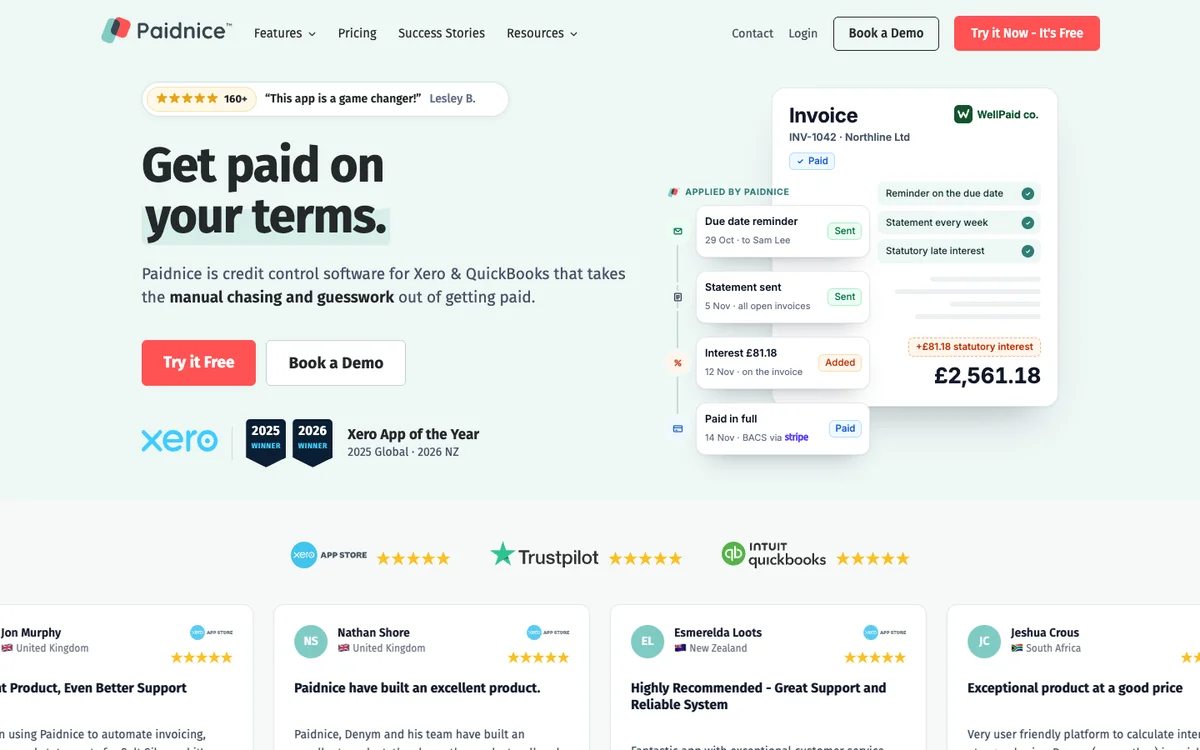
Connect the Xero organisation and it evaluates every invoice against your policies, then runs the sequence: escalating reminders and statements by email and SMS (from your own authenticated domain on Pro), statements including consolidated parent and child accounts, payment plans on Pro, a customer payment portal, and escalation through manual task workflows.
Reminder sequences sit under customer groups, so a wholesale group, a retainer group and a disputed-accounts group each run their own ladder at the same time, which is the limit a Xero user hits first, and Xero's single organisation-level schedule offers no way around it.
On the write-back side, both charge types land in the Xero organisation as invoices rather than as text in an email, raised Draft or Approved so a controller can review one before the customer sees it, and calculated on the balance net of any credit sitting on the account.
A statement recalculates its interest at the moment it sends rather than at the last policy run, so the figure a Xero customer opens on Monday morning is Monday's figure.
Limitations with Paidnice. Xero and QuickBooks Online connect on every plan. Newer ledgers such as Rillet, Campfire, Digits, DualEntry, Puzzle, Accounting Seed and Odoo are available on every plan through Paidnice's closed testing program. Sage Accounting and other ERPs connect on the Custom plan, so a group running Xero alongside NetSuite needs Custom.
Some payment features differ between the two ledgers, the entry tier covers two team members, and payment plans and sending from your own domain start on Pro rather than on the £49 plan.
The self-serve channels are email and SMS. Posted letters are on Pro and up, on request, at £1.50 each in the UK, and there are no automated calls; a person calls in-app, recorded and transcribed.
2. Chaser, best for letters and bureau checks
Best for: Xero teams that want SMS, letters and credit checks in the same tool, under £4m on the entry tier.
What is Chaser best for?
For a Xero finance team with a named credit controller that wants email, SMS, posted letters and Creditsafe credit checks running from one system.
- Fits
- Businesses with a named credit controller; Compact is for turnover under £4m, Core from £4m, and Complete runs to £100m
- Regions
- UK-registered, trading since 2014, sells worldwide. Automated calls are not available in New Zealand
- Entry cost
- £199/mo on Compact for turnover under £4m with 4 users; Core £599/mo under £10m; Complete £899/mo to £100m.
- Rated
- 4.98 from 374 Xero App Store reviews; 4.3 from 71 on G2; 4.9 from 45 on Capterra · Xero App Store listing
- Awards
- Finalist, UK Small Business App Partner of the Year, Xero Awards 2023
- Runs on
- Xero, QuickBooks, Sage 50, Sage 200, Sage Intacct, Sage Business Cloud Accounting, NetSuite, Dynamics 365 Business Central, AccountsIQ, SAP, HubSpot, Gmail, Outlook
- Statutory late fees
- Yes. Four calculation types including a Bank of England base rate type, recalculated daily, but one set of rules for the account, applied to every debtor or to selected debtors, and no fee is raised on payment-plan invoices; Chaser's help says a late fee cannot be added or updated after a part payment when written to Xero. Line-item sync of the fee is Xero-only
- Does best
- Creditsafe credit checking and monitoring in the same tool as email, SMS and letter chasing
- Customers
- Named on its website: Pact Coffee, Huttie and TaxAssist. Huttie's case study reports £15,000 of old debt recovered.
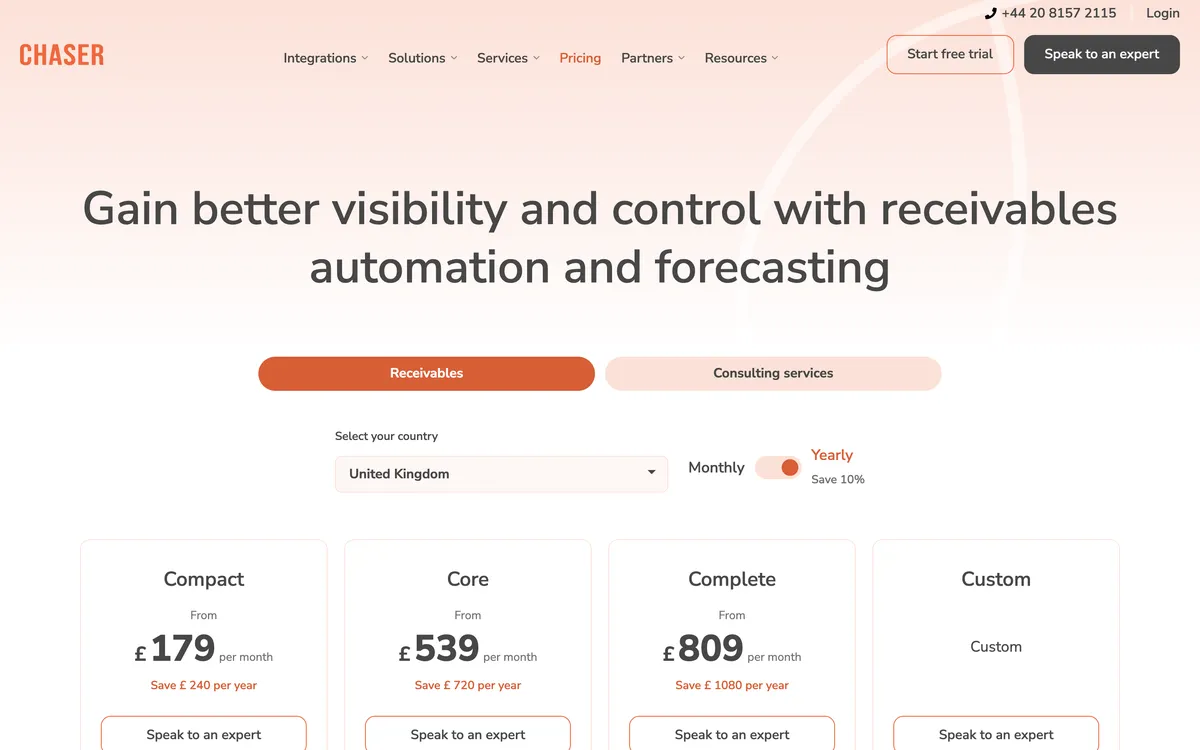
Reminders send from the team's own Gmail or Outlook mailbox, which keeps replies in the thread the customer already knows, with SMS, posted letters, one-way automated calls, a payer portal and integrated collections through a partner network. Channels are metered by credit, so a heavy chasing month costs more than a quiet one.
It also carries a Creditsafe report in the app, broken down in the review of the best credit control software. Credit checks are sold by credit on any plan; they need Chaser billing, not Xero App Store billing, and monitoring is not offered in Australia. On the Xero side the detail worth knowing is that the late fee syncs as a line item, and that line-item sync is Xero-only among the ledgers Chaser supports.
Limitations with Chaser. Chaser's help says a late fee cannot be added or updated after a part payment when written to Xero, and part payment is routine in Xero: a customer who pays half a balance to buy time silently switches the fee off on exactly the invoice most likely to need one.
The same applies to any invoice on a payment plan. The rules cover the account or selected debtors, at one rate for all of them, with no documented way to run different rules per group. Statements go monthly only, on a fixed day, Compact caps the team at four users, and the price steps by company turnover rather than by invoice volume.
3. Kolleno, best for trigger-based chasing
Best for: Order-to-cash teams chasing across email, SMS and calls.
What is Kolleno best for?
For an order-to-cash team on Xero that wants trigger-based chasing workflows and remittance parsing in the same platform as well as reminders.
- Fits
- Order-to-cash teams: BusinessPay for turnover under £1m, Business Plus £1m to £100m, Enterprise £100m to £1bn
- Regions
- London head office, founded 2020, selling internationally
- Entry cost
- $650 per user a month on BusinessPay, $545 on annual billing, minimum one user, for turnover under £1m; Business Plus $1,245 per user.
- Rated
- 5.0 from 18 Xero App Store reviews; 4.9 from 117 on G2; 5.0 from 8 on Capterra · Xero App Store listing
- Awards
- G2 Best Software Awards 2024
- Runs on
- NetSuite, SAP S/4HANA and Business One, Sage Intacct, Business Central, Workday, Oracle JD Edwards, Epicor, Infor, Odoo, Zuora, Xero, QuickBooks Online
- Statutory late fees
- None found. No feature page or help article documents a late fee or interest calculation
- Does best
- Trigger-based chasing workflows that branch on invoice creation, ledger payment, email bounce and file upload, with run-hour restrictions and automatic escalation
- Customers
- Named on its website: Wise, Deel and Laundryheap. Laundryheap's case study reports 94% of payments collected on time.
Kolleno chases across email, SMS and calls, with SMS and call allowances published on every tier, and its workflows are the most conditional here: branches, run-hour restrictions and automatic escalation rather than a fixed ladder of dates.

Kolleno lists AI agent support from Business Plus as insights, a copilot that drafts messages for review, and an agent that works a collections policy on its own. Fully automated agent runs and AP portal features are billed separately by token use.
Kolleno matches payments to invoices (auto-reconciliation) on Enterprise only, by quote; BusinessPay at $650 per user a month does not include it. Xero and QuickBooks connect on BusinessPay and Business Plus; NetSuite and SAP start on Enterprise. What it puts back into a Xero organisation is matched cash rather than a charge, and that reconciliation depth is treated at length on the credit control software comparison.
Limitations with Kolleno. It is priced for a company that has outgrown a Xero-only stack: $650 per user a month on BusinessPay without workflow automation, nearly doubling on the second tier, in dollars. Nothing documents a late fee or an interest calculation, so the sequence ends in another message.
Kolleno's pricing page does not say which actions a workflow can hold, and reviewers name navigation and reporting depth as the recurring weak points.
4. Upflow, best for analytics-led finance
Best for: Analytics-led Xero teams, five gross invoice value tiers from up to $10m to above $100m.
What is Upflow best for?
For a finance team on Xero that manages collections by metric and wants countback DSO and collection effectiveness measured before it automates anything.
- Fits
- B2B finance teams that manage by metric, quoted in five tiers by gross invoice value, from up to $10m on Starter to above $100m on Enterprise
- Regions
- New York head office, Paris origin, customers in 30-plus countries
- Entry cost
- Not published. Upflow prints no figures and quotes five tiers by gross invoice value; its pricing FAQ mentions a free Discover plan for analytics, but it is not among the plan cards. Upflow’s last published prices were $440 a month for Grow and $880 for Scale.
- Rated
- 4.8 from 235 G2 reviews; 4.5 from 15 on Capterra; 5.0 from a single Xero App Store review · Xero App Store listing
- Awards
- Not published
- Runs on
- Xero, QuickBooks Online, NetSuite, Sage Intacct, Stripe Billing, Chargebee, Zuora
- Statutory late fees
- No, via your ledger only. Upflow’s own documentation points the job back to the ledger and there is no native computation
- Does best
- Collections analytics, with countback DSO against best possible DSO, collection effectiveness and an at-risk rate above 90 days
- Customers
- Named on its website: Lattice, Vercel and Front. Lattice's case study reports 99% collection with one person in AR.
Upflow chases through multi-step workflows with email, SMS, letter, call and task actions, timed against invoice age, customer behaviour and risk profile, with a branded portal, saved payment methods, dispute tracking and customer-set promises to pay.
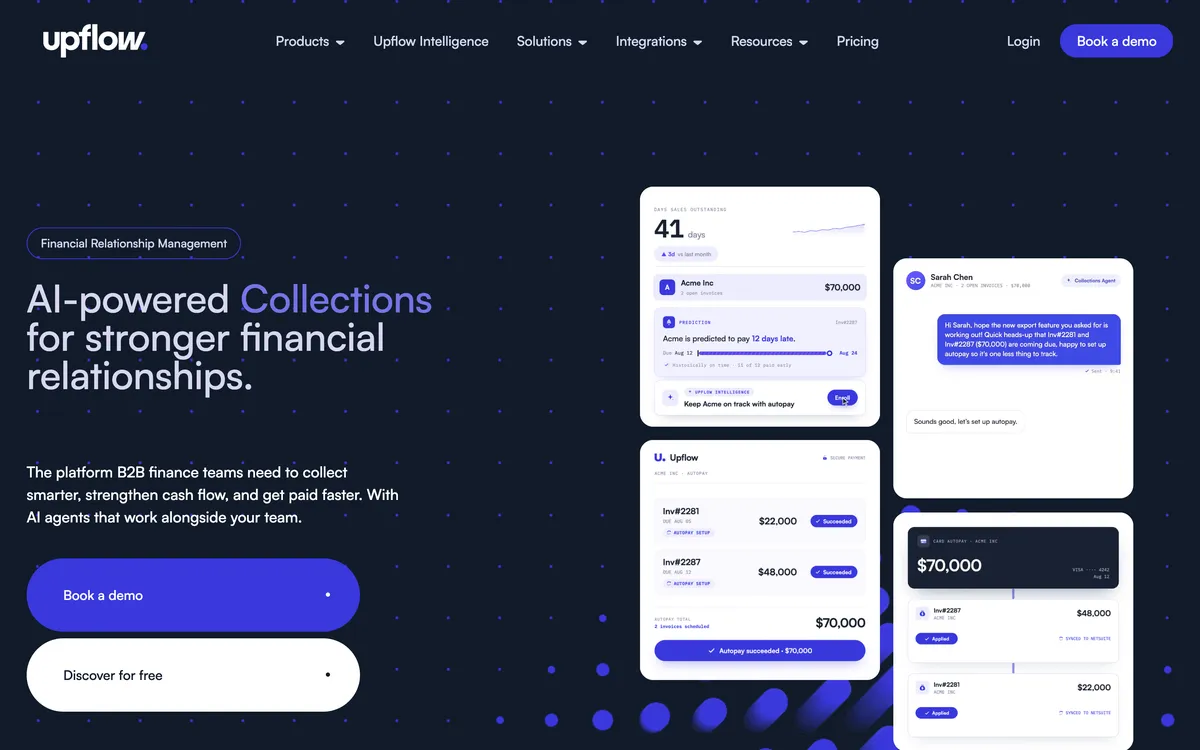
The reason to pick it is the measurement rather than the chase, and the Xero buying guide works through which of its measures are worth managing to. The free Discover tier will read a Xero organisation and produce them while chasing nobody, which makes it a way to take a baseline before you commit to any tool on this page.
Limitations with Upflow. Its Xero App Store base is one review, which is why it places on its G2 record rather than on the platform this page otherwise uses. Nothing is written back as a charge: fees are pointed at the ledger, and there are no instalment plans, only customer-initiated part payments.
Calls and tasks are manual by design, automatic actions run once a day on business days only, sending through your own SMTP costs open and click tracking, and its last published prices were $440 a month for Grow and $880 for Scale, and current prices are hidden, so request a quote.
5. Satago, best for UK credit reports
Best for: UK Xero businesses that want credit reports alongside their chasing, no revenue band published.
What is Satago best for?
For a UK business on Xero that wants customer credit scores and suggested limits, and invoice finance, from the same provider that runs its chasing.
- Fits
- UK businesses in the Xero and Sage ecosystem. No revenue band published
- Regions
- United Kingdom only
- Entry cost
- £45/mo Basic standalone, £80 Premium, £200 Platinum. The cheaper £25 Standard and £45 Plus tiers are the Sage 50 embedded edition, which a Xero business cannot buy. Satago offers a 14-day free trial.
- Rated
- 4.93 from 92 Xero App Store reviews, 96% five-star · Xero App Store listing
- Awards
- Not published
- Runs on
- Xero, Sage, Sage 50, QuickBooks, KashFlow, FreeAgent
- Statutory late fees
- Optional. Late fees are calculated in line with statutory limits and added to payment reminders once an invoice is overdue
- Does best
- Credit reports, customer credit scores and suggested credit limits bundled into the same subscription as the chasing, with invoice finance from the same provider
For a Xero business the only product in play is the standalone plan at £45 a month, covering reminders, statements, customer grouping and scheduling with credit reports metered by tier. The cheaper tiers that appear in price comparisons belong to the Sage 50 embedded edition and cannot be bought against a Xero connection at all.
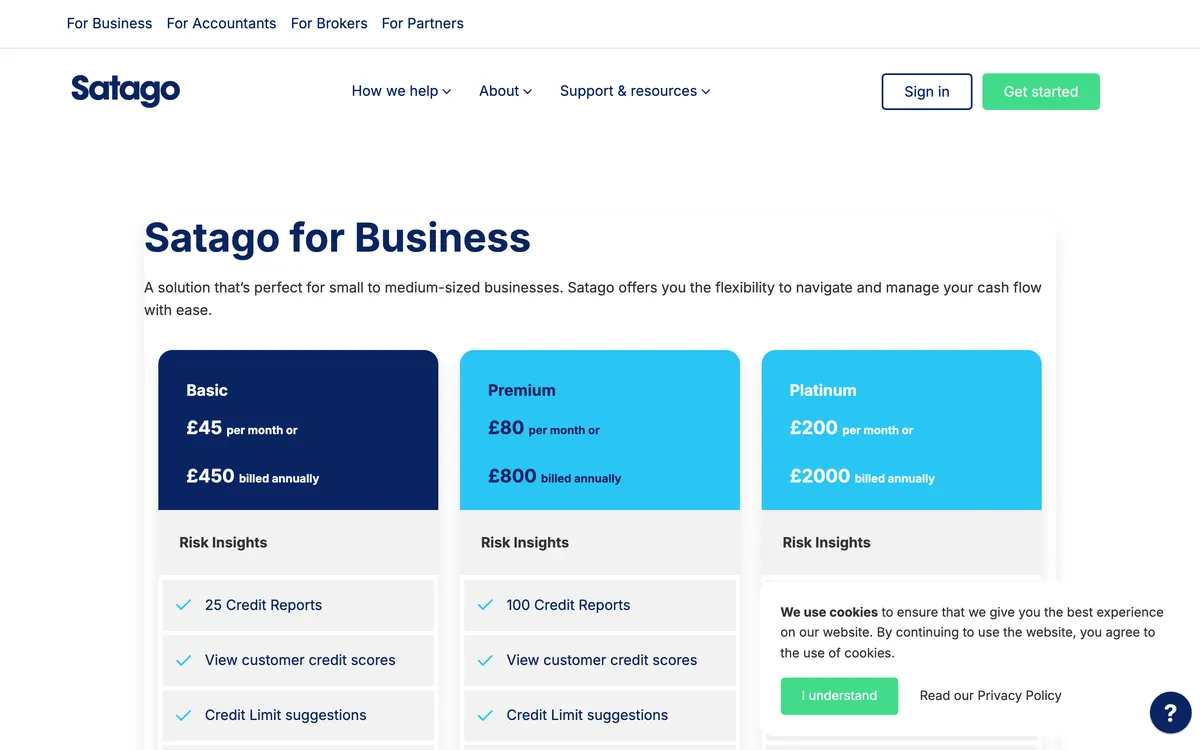
The credit layer is the reason to buy it.
Limitations with Satago. A hundred email reminders a month on Basic is a low ceiling for a Xero organisation of any size, and no own-inbox sending is listed on Basic, so your own inbox and 100 SMS a month mean the £80 Premium tier.
The late fee is optional and added to reminder emails; writing a charge to the ledger is not documented. The footprint is UK-only.
What sends reminder six after Xero's five?
Five steps is where Xero itself stops. On a dedicated tool the same ladder runs per customer group, changes channel partway, and carries a charge at step four.
Two things fall out of the comparison. Only two of the five end the sequence in a charge rather than in another message, and only one ends it in a charge that can differ between two customer groups.
What is an automatic invoice chaser for Xero?
Four of the five here run fully unattended. Paidnice runs the ladder from a policy per customer group, on email and SMS, then raises the charge itself. Chaser runs it on email, SMS, letter and automated call, with channels metered by credit.
Kolleno branches workflows with automatic escalation. Satago sends automatically with a cap of 100 email reminders a month on the Basic tier. Upflow is the exception: automatic actions fire once a day on business days, and the call step is a task for a person.
Does the app stop on a part-payment, on a credit note, or only on a fully settled invoice?
Paidnice reads account balances including credits and nets the charge against them. The others read invoice payment status, and the behaviour on a part-paid invoice should be checked in a real Xero organisation before go-live.
Which channels beyond email can chase a Xero invoice?
Xero sends email. Every other channel on this page is something you are buying, and they are not interchangeable.
SMS is the cheap escalation and the one most businesses underuse. Paidnice sends it from the same policy that runs the email ladder, so the switch to SMS is a step in the sequence rather than a separate tool.
Chaser meters it as credits on top of the plan. Kolleno publishes SMS allowances on every tier. Upflow sends it automatically. Satago holds it back to the £80 Premium tier.
Chaser and Paidnice both send posted letters; on Paidnice they are on Pro and up, on request. They cost more than everything else and they are the channel a customer's accounts payable clerk cannot mark as read and forget, which is exactly the point on a debt heading towards recovery.
Calls split the field in a way the marketing does not. Chaser sends one-way automated calls, and they are not available in New Zealand.
Kolleno includes 100 to 600 calls a plan. Its pricing page does not say which actions a workflow can hold.
The sending address matters as much as the channel. Chaser sends from the team's own Gmail or Outlook mailbox, so a reply lands in the inbox somebody is already reading.
Paidnice sends from your own domain, which starts on Pro, or through a connected Gmail or Outlook (Microsoft 365) mailbox.
What a Xero connection actually writes back
Every one of these five reads from Xero. What separates them is what goes back into the organisation your accountant will open at year end.
An app that only reads cannot enforce anything, whatever the enforcement language on its homepage says. It can send a message describing a charge, and the charge will not exist anywhere your customer's payables team can see it, will not age on your ledger, and will not appear in any report either of you runs.
| App | Reads from Xero | Writes back to Xero | Raises a charge in Xero |
|---|---|---|---|
| Paidnice | Invoices, payments, contacts and account balances, including credits on the account | Late fee and statement interest charges, plus payments taken through the portal | Yes, as Draft or Approved, calculated net of any credit on the account |
| Chaser | Invoices and payment status | The late fee, synced as a line item, which is Xero-only among its ledgers | Yes, on one set of rules, and not on part-paid or payment-plan invoices |
| Kolleno | Invoices, payments and remittance data for cash application | Matched cash and reconciliation output, on Enterprise only; nothing further is documented for Xero specifically | None found. No feature page or help article documents a late fee or interest calculation |
| Upflow | Invoices, payments and customer contacts | Nothing documented beyond the read. Chasing activity and promises to pay stay on the Upflow side | No. Its own documentation points fees back to the ledger |
| Satago | Invoices and payment status | Reminders, statements and grouping; write-back beyond that is not documented | Optional late fee added to reminder emails. Writing a charge to the ledger is not documented |
The Draft option in the first row is the detail worth taking into a demo. A charge that appears as a Draft is one a controller reviews before a customer ever sees it.
Ask each vendor to show you the object it creates, in a real Xero organisation, before the trial ends.
What is the best debtor tracking software for Xero in the UK?
Debtor tracking on Xero means an aged receivables view that the chasing runs from, statements on a schedule, and a portal the customer can see the balance in. Paidnice and Chaser cover all three; Satago covers statements.
Xero's own aged receivables report is where tracking starts, and every app here reads from it. The comparison table above shows what each adds: Paidnice buckets the aged view by contact in 30-day bands, Upflow adds countback DSO and an at-risk rate above 90 days, and Chaser, Kolleno and Satago read Xero's own report.
For a UK ledger, the tracking question is whether the overdue balance carries the statutory interest on it. A statement that prints the charge is what turns tracking into collection, and on this page only Paidnice raises a statement interest charge against the whole overdue balance, calculated net of any credit on the account.
What invoice chasing software for Xero costs in 2026
Published entry prices on the Xero connection: Satago £45 a month standalone, Paidnice £49 (US$69), Chaser £199, Kolleno $650 per user. Upflow's last published prices were $440 a month for Grow and $880 for Scale; current prices are hidden, so request a quote. Check current pricing with the vendor.
Chaser meters SMS, posted letters and calls as credits on top of the plan, so a quarter with a difficult ledger costs more than a quiet one, and its tiers step by company turnover rather than by how many invoices you chase.
Kolleno charges per user, so a second and third person on the credit control function multiply the bill before anything else changes. Paidnice charges by invoice volume on a flat tier with no per-seat fee above the entry plan, and payment plans and custom-domain sending start on Pro.
Which invoice chasing software for Xero fits your use case?
| Use case | Start with | Why |
|---|---|---|
| Mixed customer groups and statutory interest | Paidnice | A policy per customer group raises the charge in Xero as Draft or Approved |
| Reminders and statements only, no charge | Paidnice or Satago | Both run reminders and statements on Xero; Satago caps Basic at 100 emails a month |
| Posted letters, automated calls and credit checks | Chaser | Sends posted letters and automated calls, with Creditsafe reports in the app. Consider Paidnice for the chasing around it, with escalation workflows |
| Cash application alongside the chasing | Kolleno | Matches payments to invoices (auto-reconciliation) on Enterprise only, by quote. Consider Paidnice for the chasing around it |
| A collections baseline before you buy | Upflow | The free Discover tier reads a Xero organisation and reports without chasing anyone |
| Credit scores before you extend terms | Satago | Scores and suggested limits arrive before the terms go out |
Questions Xero users ask
How many times will Xero chase an invoice?
Five. The reminder schedule holds up to five reminders per invoice, it is set once for the whole organisation rather than per customer, and it sends from a Xero address. There is no sixth step and no charge at any step.
Why can't Xero add interest to a late invoice?
It has never built the feature. The request has sat on the Xero ideas board since 29 March 2012 with 1,118 votes, and Xero's response of 7 July 2025 says there are no committed plans. Paidnice and Chaser both add the calculation and write the charge back to Xero.
What sends the sixth reminder?
Whichever of these five you connect.
Paidnice and Chaser continue on email and SMS with a charge at the end of the ladder, Chaser adding posted letters and one-way automated calls; Kolleno branches into workflows with automatic escalation; Upflow sends email, SMS and letters automatically and leaves calls to a person; Satago continues on email, with SMS from its £80 tier.
Which of these actually write something back into my Xero organisation?
Paidnice raises late fee and statement interest charges as Draft or Approved and posts portal payments. Chaser syncs its late fee as a line item, which is Xero-only among the ledgers it supports. Kolleno writes matched cash from its reconciliation, on Enterprise only. Upflow and Satago document no charge written back at all.
Can I keep replies coming to my own inbox?
Yes on Chaser, which sends from the team's Gmail or Outlook mailbox, and on Paidnice, which sends from your own domain (Pro) or through a connected Gmail or Outlook (Microsoft 365) mailbox. Satago's Basic tier does not list own-inbox sending and your own inbox starts at the £80 Premium tier.
Do the Xero App Store ratings tell me anything useful?
More than usual, because all five apps hold a listing on the same platform under the same review policy, which is rarely true of a software comparison.
What does invoice chasing software for Xero cost?
Satago £45 a month standalone, Paidnice £49 (US$69), Chaser £199 for turnover under £4m, Kolleno $650 per user a month for turnover under £1m, and Upflow's last published prices were $440 a month for Grow and $880 for Scale, now hidden, so request a quote. Check current pricing with the vendor, and check what the channels cost on top before you compare them.
For tools on other ledgers, the credit control software buyer’s guide compares six tools across Xero, QuickBooks Online, Sage, NetSuite and Business Central.
Next for a Xero organisation
Buyer's guide
Best accounts receivable software for Xero
The wider Xero receivables field, including tools that do more than chase.
Buyer's guide
Credit control software for Xero
The five decisions that come before a shortlist, in the order to take them.
How-to
How to add late payment fees in Xero
The Xero method, the no-VAT treatment, and how to automate it.
Buyer's guide
Best credit control software UK
What UK law lets you charge once the reminders have run out.
Sources
14 sources, checked by Julie Turnbridge on November 3, 2026
- Xero ideas board productideas.xero.com/forums/967115-invoices-quotes/sugge...
- Yes, UK store apps.xero.com/uk/app/paidnice
- Yes, UK store apps.xero.com/uk/app/chaser
- Yes, UK store apps.xero.com/uk/app/kolleno
- Yes, UK store apps.xero.com/uk/app/upflow
- Yes, UK store apps.xero.com/uk/app/satago
- Capterra capterra.com/p/254868/Paidnice
- G2 g2.com/products/chaser/reviews
- Capterra capterra.co.uk/software/157101/chaser
- G2 g2.com/products/kolleno/reviews
- Capterra capterra.co.uk/software/227932/Kolleno
- G2 g2.com/products/upflow-upflow/reviews
- Capterra capterra.co.uk/software/193097/Upflow
- Xero App Store listing apps.xero.com/us/app/upflow